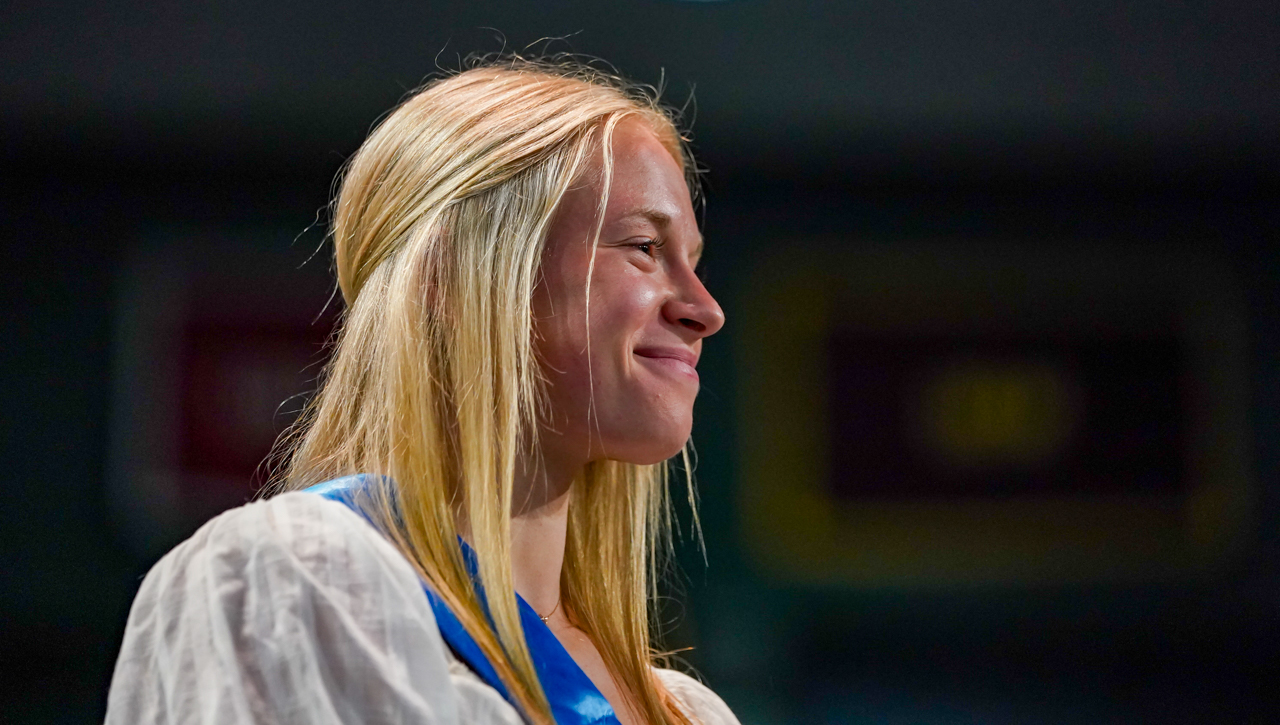
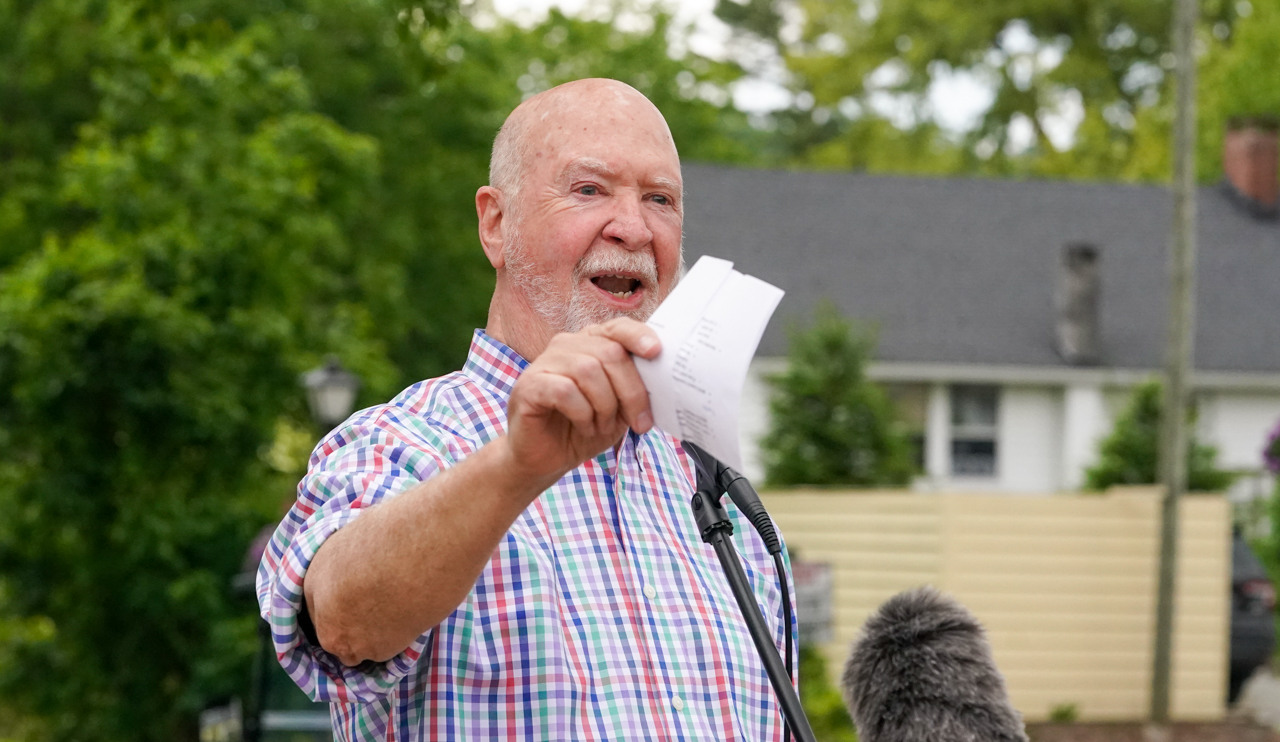
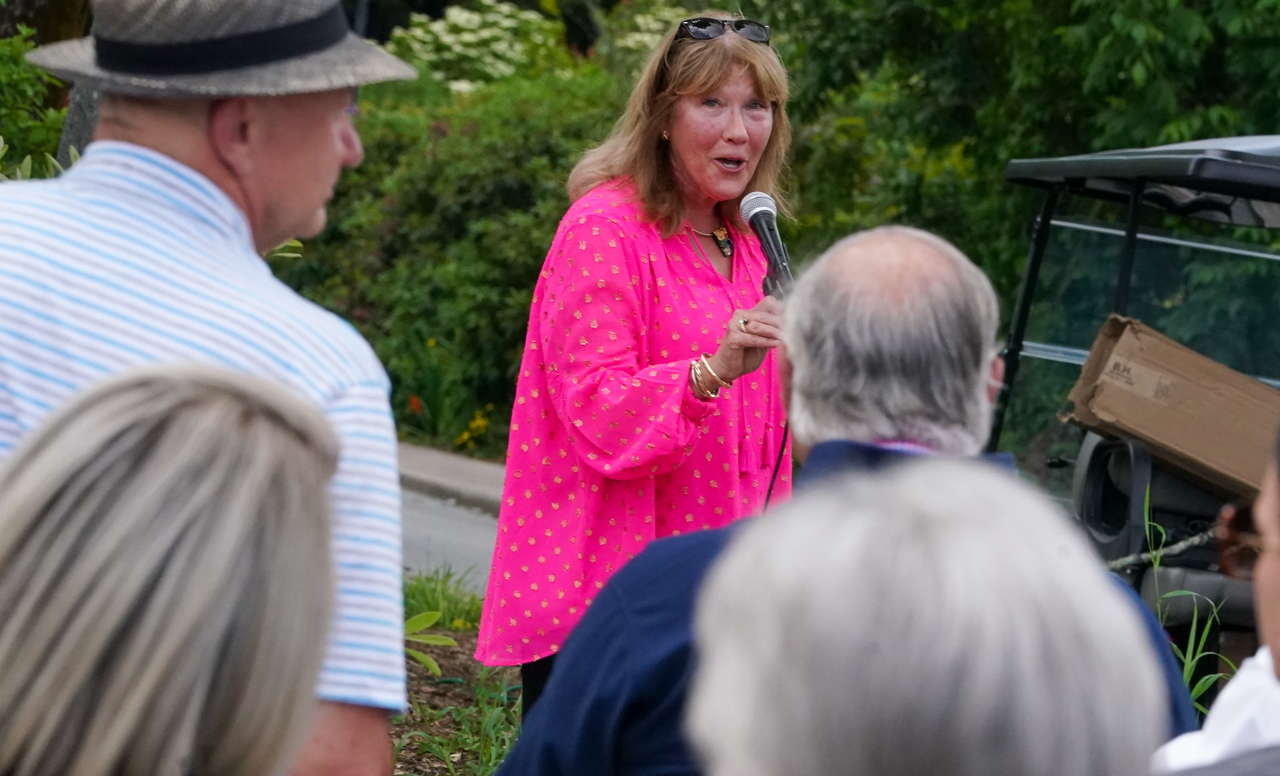
By David Rogers. BOONE, N.C. — A picture often represents a thousand words, so there is very little to say except that we were blessed to have witnessed the graduation of Watauga High School’s remarkable 2023 class. Great music, meaningful speeches, enthusiastic cheers from the crowd surrounding (and supporting) the grads, and of course those priceless moments… Congratulations to all who are starting their next chapter of life’s adventures.
By David Rogers. BLOWING ROCK, N.C. — With a nod toward change being inevitable, even accelerated with advances in technology, former Lees McRae College president and Blowing Rock historian Dr. Barry Buxton articulated what history means on June 1.
Buxton told the estimated 150 people gathered for the Blowing Rock History Walk ribbon-cutting, “Blowing Rock has been discovered and along with that comes a lot of new people to our community. These new people know very little about the history of Blowing Rock. They love this place, but they don’t know much about the men and women who over a century helped shape this place, who have helped make it an anomaly in the High Country, who have made it so special.
Dr. Barry Buxton articulated the importance of history to each of us on June 1, at the American Legion Building, following the cremonial ribbon cutting for the new Blowing Rock History Walk. Photographic image by David Rogers
“One of the things we are trying to do (with the History Walk) is to honor those individuals. History is who we are, is why we are and is the way we are. History is important to every one of us. We may not think of it that way but we are the people we are because of history,” Buxton added.
In concluding his remarks, Buxton encouraged the longtime residents who grew up here, the relative newcomers, and even the visitors to town to always have an eye on the town’s history.
History is who we are, why we are, and the way we are…
“Let’s let history shape our decision-making,” Buxton concluded. “Let’s let history help inform what we decide to do with our community. We must work with our mayor, town council and other (stakeholders) to guide this community forward so that we retain the special qualities that we all know and love.”
Photographic image by David Rogers
While Blowing Rock Historical Society President Tom O’Brien and Village Foundation president Cathy Robbins took charge of the ribbon-cutting ceremonies at the History Walk starting point just west of Main Street, along the Laurel Lane sidewalk, the program at the American Legion building hosted reception featured comments by Buxton, O’Brien, and a lengthy list of “thank-yous” and acknowledgements from Village Foundation founder John Aldridge, including the Town of Blowing Rock, architect Jim Pitts, the stonemasons he referred to as “Rock Stars.” and the many donors who each sponsored one of the monuments/
Several years ago, Aldridge recalled, when O’Brien had first become president of the Historical Society, they met and Aldridge shared his vision for the project. “I told Tom that if he and his team could put together the people, places and narratives to feature, that we would do the design work and raise the money,” said Aldridge. “Tom said, ‘Ok, let’s do it.’”
John Aldridge, founder of the Village Foundation, had the original vision for the Blowing Rock History Walk to remember and honor the people, places, and events that shaped the town and helped make it a special place to live, work and play. Photographic image by David Rogers
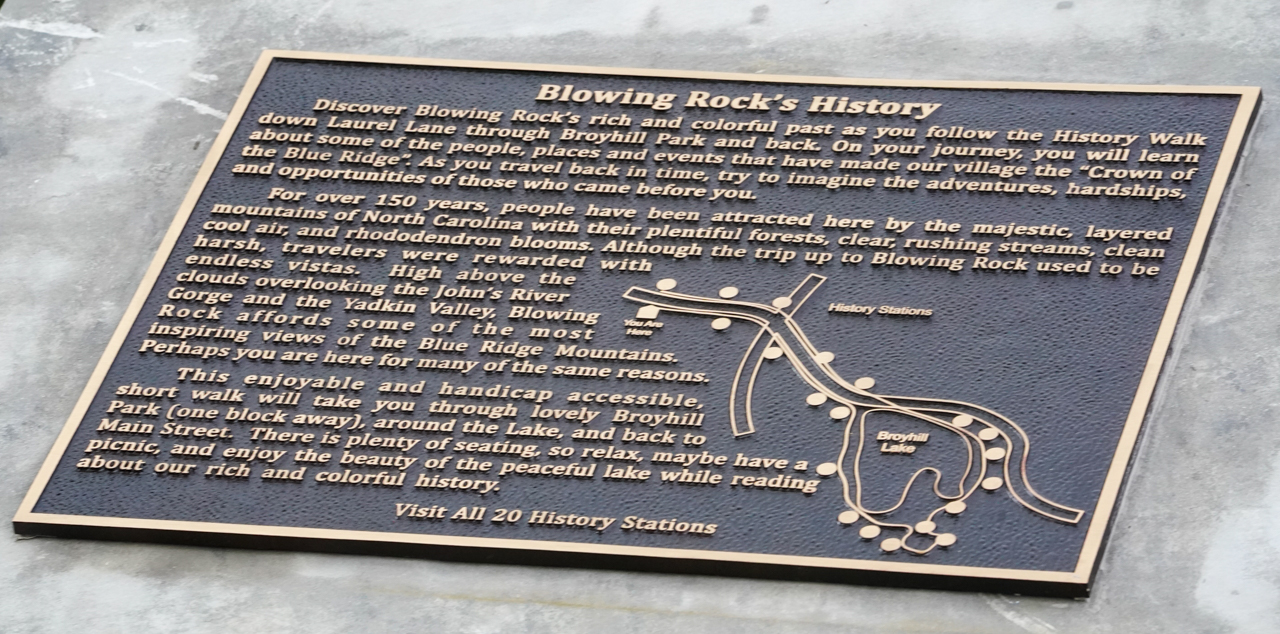
The Blowing Rock History Walk is a series of 21 monuments, each one with a bronzed plaque inscribed with a historical narrative about people, places and events important to Blowing Rock history. That path goes down Laurel Lane, and around Broyhill Lake, each stopping point with a monument, plaque and even a bench where visitors can sit and reflect.
tom said, ‘ok, let’s do it.’
“With the History Walk now a reality,” said Aldridge, “People are already asking us, ‘What’s next?’ Well, we are talking with the town about doing something with the Glen Burney Trail to make it safer and even more enjoyable. That is Phase I. We are thinking about a Phase II that expands on the Annie Cannon Gardens. Phase 3, if we can do it, is Legion Hill.”
O’Brien concluded the festivities with an invitation for people to join the Historical Society if they have not already done so.
Tom O’Brien, president of the Blowing Rock Hisotrical Society, was instrumental in committing the organization to the History Walk project and coordinating the various stakeholders. He emceed both the ribbon cutting and the American Legion building reception on June 1. Photographic image by David Rogers
“This party was put on by the Blowing Rock Historical Society,” said O’Brien. “We have an events committee, including Suzanne McBee and Lori Trexler, who are the co-chairs. Nobody has better events than we have. These ladies are just spectacular. Our dues for membership are very small but we use those funds to do things for our community. Like this History Walk, in which we invested quite a bit.”
Mayor Charlie Sellers reflected on Blowing history and what the new Blowing Rock History Walk means to the town on June 1, at the ribbon-cutting. Photographic image by David Rogers
Asked about the development from his organization’s perspective, Blowing Rock Chamber of Commerce CEO Charles Hardin said, “I think this is going to be a great asset for the town, especially because it honors and remembers many of those people who helped shape this special place, as Dr. Buxton said. It will also help both our residents and the many visitors not just something else to do, but to have a sense of connection to the town. You know, the North Carolina Governor, Roy Cooper, recently declared 2023 as the ‘Year of the Trail’ so our creation of this History Walk is very timely.”
Blowing Rock History Walk is free for all to enjoy. The best starting point is at the monument near the intersection of Main Street and Laurel Lane.
Village Foundation president and Tweetsie Railroad principal Cathy Robbins addressed the crowd estimated at 150 on June 1, gathered at the start of the Blowing Rock History Walk for its ribbon cutting ceremony. Photographic image by David Rogers
By David Rogers. BLOWING ROCK, N.C. — Under normal circumstances, making a hole-in-one on a long par-5 is challenging, if not impossible for all but the most superhuman of golfers. Thanks to a mixture of gimmicks common to many charity fundraisers, such aces can be a dime a dozen — and they bring great smiles while serving a terrific cause.
In a former life, Jeff Crittenden may have been the front man for a traveling medicine show, hawking “magic” elixirs to coax dollars and cents out of the pockets of the gullible. On May 9, he was a fun addition to the Coaches Golf Tournament at Blowing Rock Country Club, in benefit of the High Country Caregivers non-profit.
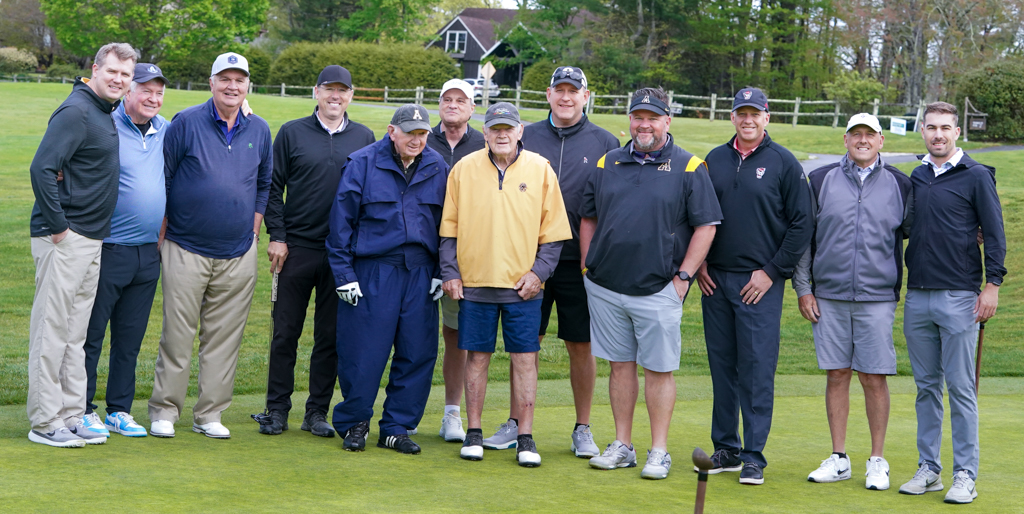
Left to right: Dustin Kerns, Mack Brown, Paul Johnson, Scott Satterfield, Oval Jaynes,Sparky Woods, Jerry Moore, Shawn Clark, Lance Ware, Dave Doeren, Clay Hendrix, Trey Kavanaugh. Photographic image by David Rogers
Crittenden is a 2-time winner of the World Long Drive Championship in the Masters Division (2017 and 2019) and a 2014 near winner in the regular man’s division.
For the Coaches event, Crittenden was positioned near the championship tees at BRCC’s No. 11, entertaining the golfers as they came through with trick shots and drives that made even the most burly of duffers gulp in awe. For an extra donation — and there were many takers — you could use one of his drives (straight up the fairway, more than 300 yards) or, for even more generosity in benefit of the non-profit, you could be lying “zero” on the green, roughly 15 feet from the cup. If someone in the competing foursome makes the putt it is, WHALAH!, a hole-in-one.
High Country Sports witnessed at least one “ace” during the midday event at BRCC and undoubtedly there were several more.
It was all in great fun for a good cause and there was plenty for the 72 tournament entrants and 18 coaches and celebrities to talk about — and smile about.
World Long Drive Champion Jeff Crittenden wowed the golfers all day with trick shots and monster drives that traveled well over 300 yards. ‘At sea level, I hit about 340. It might be longer today because of the higher altitude (thinner air) and the wind is blowing from behind us.’ Photographic image by David Rogers
Event organizers breathed a sigh of relief when the early morning rain stopped and it only delayed the shotgun start by a little more than an hour. Everyone was pleased that the heavy fog that blanketed the 2022 tournament did not materialize a year later.
Former Appalachian State head coach Jerry Moore, whose wife Margaret is on the High Country Caregivers board, was instrumental in bringing a lot of coaching star power to what has become one of the High Country’s most popular fundraisers. In addition to Moore, also on hand were current University of North Carolina head coach and former Texas and App State head coach Mack Brown; current University of Cincinnati and former Louisville and App State head coach Scott Satterfield; current North Carolina State head coach Dave Doeren; UNC Senior Advisor and former App State head coach Sparky Woods; current App State head coach Shawn Clark; App State Senior Assistant Lance Ware; App State Assistant Coach Trey Kavanaugh; current Furman head coach Clay Hendrix; App State men’s basketball head coach Dustin Kerns; former Georgia Tech, Georgia Southern and Navy head coach Paul Johnson; former NC State and NBA basketball player Tommy Burleson; former athletic director Auburn, Colorado State, Idaho, Pittsburgh, Chattanooga, Jacksonville State and former head coach at Gardner-Webb and assistant at Wake Forest, South Carolina, North Carolina, The Citadel, and Wyoming, Oval Jaynes; former defensive back at UNC Eric Thomas; retired U.S Marine First Lieutenant and inspirational speaker Clebe McClary; and former NFL defensive tackle Larry Hand.
There are relative few guys that App State men’s basketball head coach looks up to, physically, to any degree. Former NBA 7-footer Tommy Burleson is one of them! Photographic image by David Rogers
Paul Johnson and his team whittled away the competition with a gross score of 55 in the Captain’s Choice format, while Clebe McClary’s team leveraged Michael Comer’s “hole in one” on No. 11 to record a top finishing net score of 50.
Ron Gibson proved to be the best putter and Matt Rice executed the best second shot.
Susan Barrow proved to be the long hitter among the ladies with a longest drive on No. 3 and Michael Comer followed up his faux ace on No. 11 with a booming drive on No. 14.
Closest to the pin honors went to different golfers on each of the four par-3 holes, including Micah Fuller on No. 2, Ben Sholer on No. 6, Sam Glover on No. 15, and Dee Dee Rominger on No. 16.
The money has not all been counted, but it is known to be more than $50,000 when an anonymous donor contributed $25,000 at the May 8 dinner with the provision that it at least be matched by collective donations from others in the audience. With Blowing Rock’s Jenny Miller serving as auctioneer, some $26,000 was raised in less than 10 minutes.
Photographic image by David Rogers
Editor’s Note: This story will be updated when we have received more information.
GOLF TOP FINISHERS
1st place – Gross: Score (55) Tim Kearns, Matt Rice, William McDaniel, Cameron Pierce, Paul Johnson
2nd place – Gross: Score (56) Jay Howard, Danny Morrison, Micah Fuller, Will Pitts, Clay Hendrix
3rd place – Gross: Score (57) David Robbins, Raleigh Avery, Richard Avery, David Burleson, Tommy Burleson
1st place – Net: Score (50) Mike Doble, Bob Comer, Michael Comer, Kenny Griffin, Clebe McClary
2nd place – Net: Score (51) Mack Patterson, Taylor Patterson, Sam Akers, Sumner Patterson, Eric Thomas
3rd place – Net: Score (51) Jeff Greene, Mitchell Greene, Tim Greene, Calvin Greene, Trey Kavanaugh
Putting contest winner – Ron Gibson
Best 2nd shot – Matt Rice
Longest Drive – Susan Barrow (Ladies) Hole #3 Longest Drive – Michael Comer (Men) Hole #14
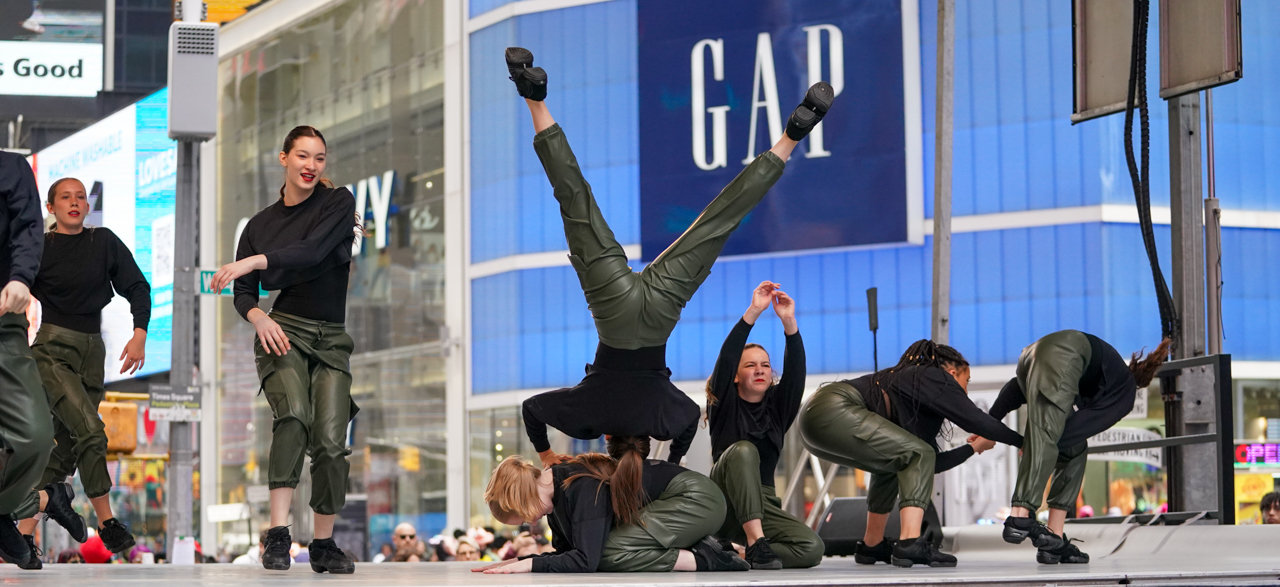
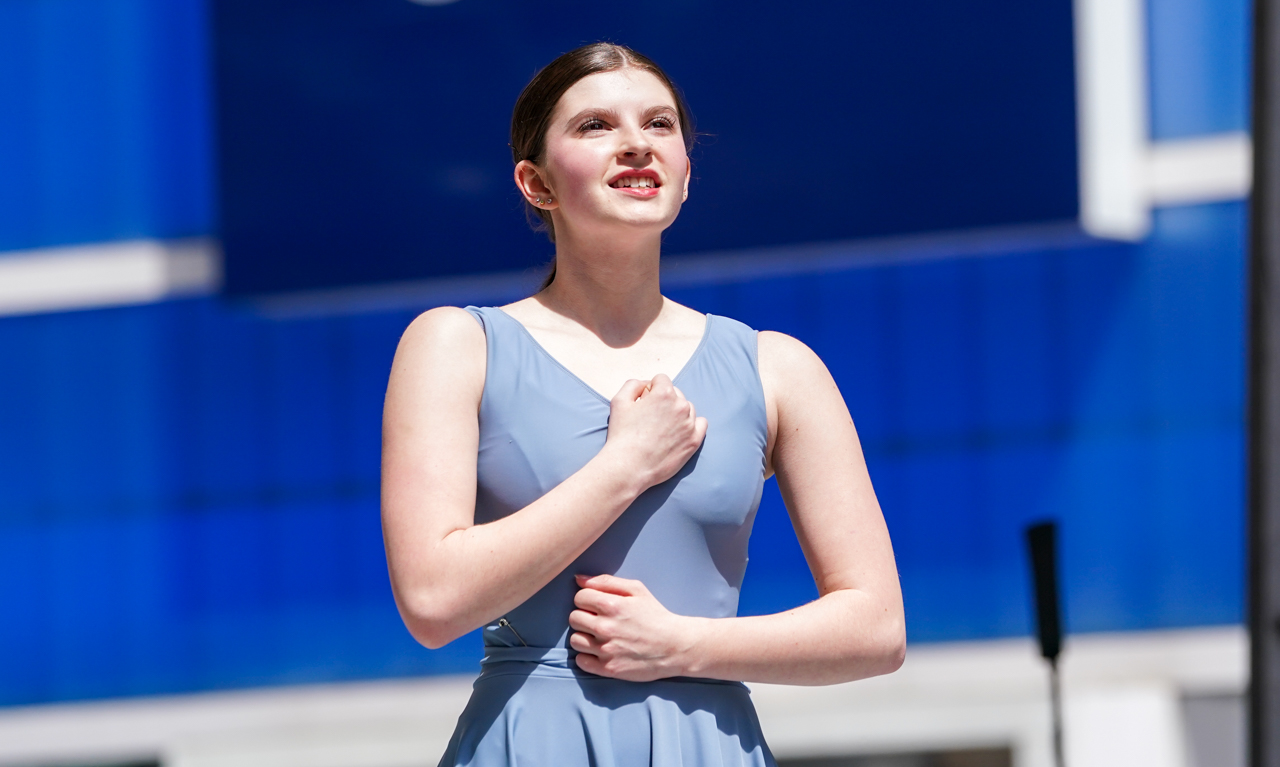
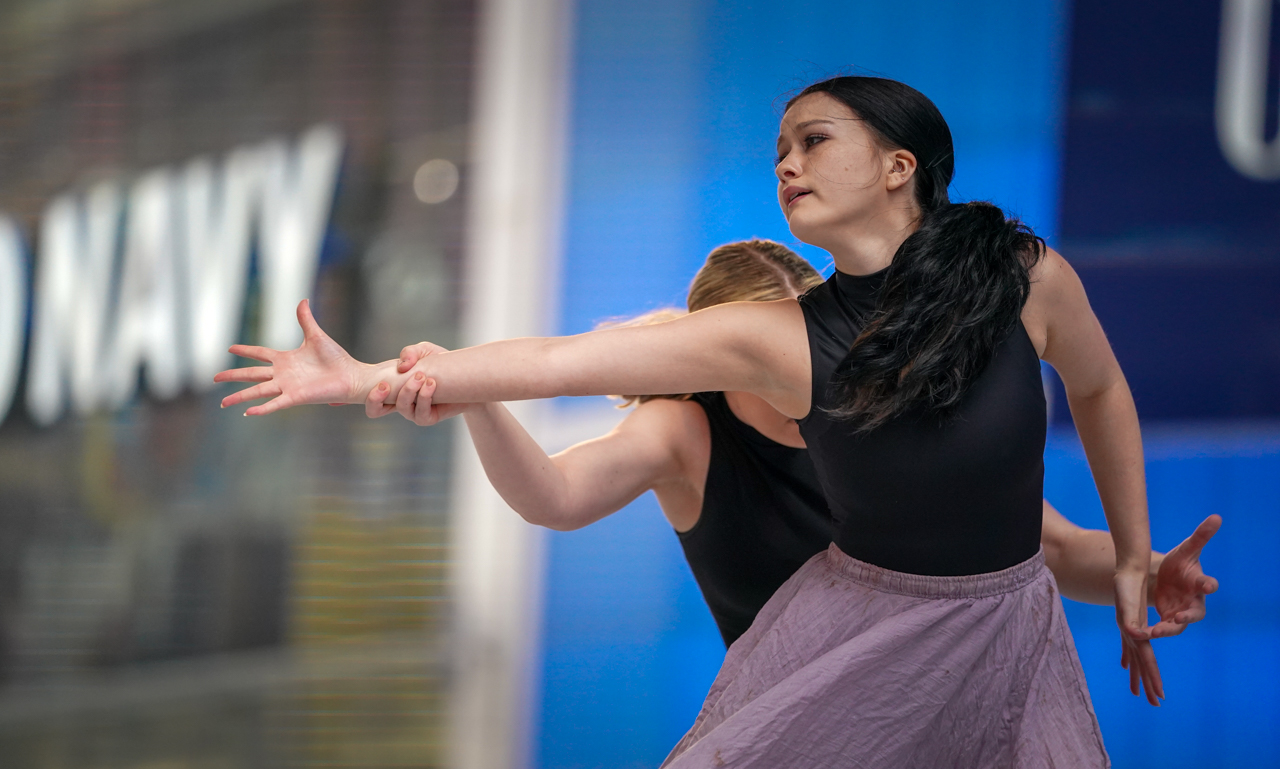
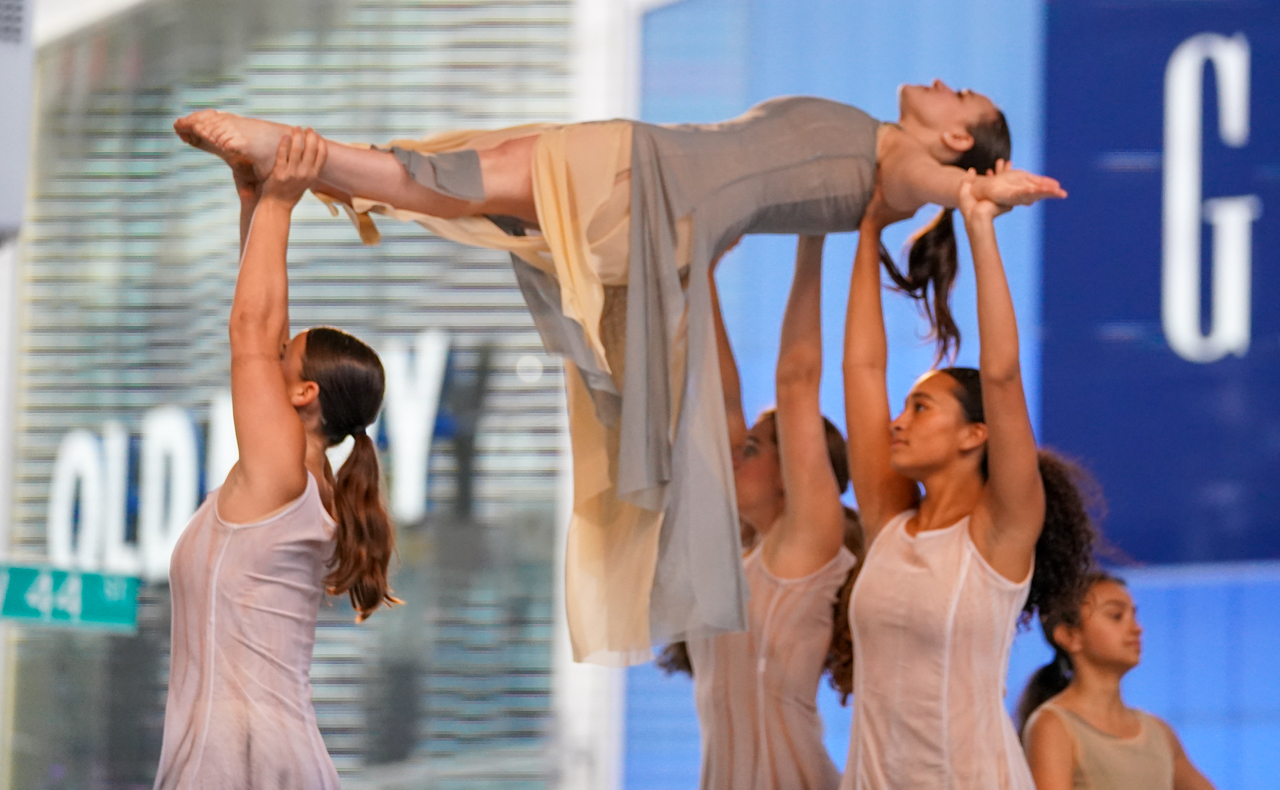
By David Rogers. NEW YORK CITY — Few places in the world rival New York City’s Times Square for conflicting visuals and that was certainly the case on April 22 when the High Country’s Carolina Snowbelles graced the pop-up stage at Pedestrian Plaza, in the intersection of Broadway, 44th Street and 7th Avenue.
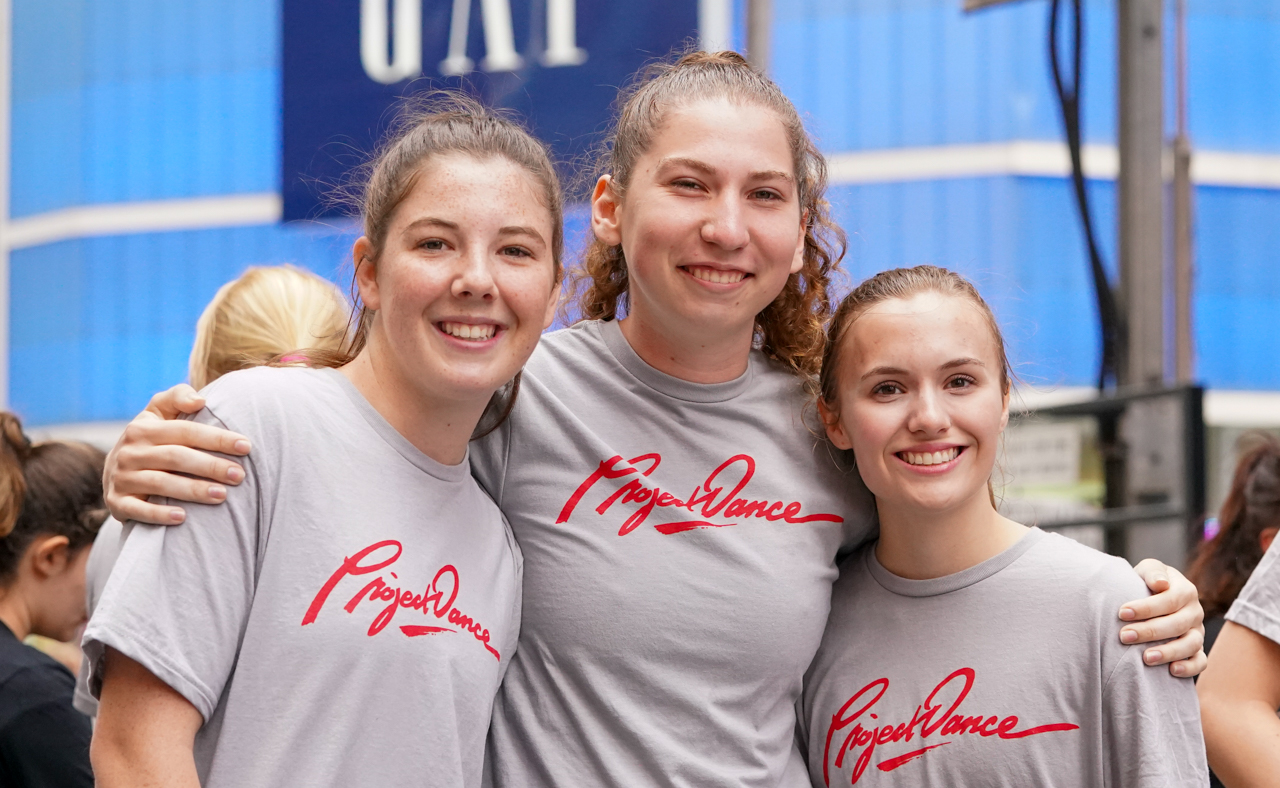
Performing as part of Project Dance, an initiative founded by Blowing Rock’s Cheryl Cutlip in 2002 to help connect New York City after the gruesome 9/11 attack on the World Trade Center, the Snowbelles’ performances brought whoops, hollars and whistles aplenty along with enthusiastic applause. The dance team formed by Cutlip at her studio, The Space at Project Dance in Boone, was all smiles while feeding off the energy that only an outdoor venue in a big city can provide. Professional theaters on every one of several blocks around them in the heart of the nation’s No. 1 theater district, this was the world of Tony Award winners of a storied past and present.
Photographic image by David Rogers
But the Snowbelles were not the only attraction of the nearly seven-hour, open-air and free dance concert in the middle of urban frenzy.
“9/11 served as the impetus for us wanting to help New York City heal,” said Jen Byers, the assistant producer and stage manager for Project Dance. “But the work continues to be important because of other calamity events like the COVID-19 pandemic, which hit New York City hard.”
Byers told High Country Sports that Project Dance has run continuously since 2002, but had to be go on a hiatus in New York for the last four years.
Photographic image by David Rogers
“This is our first year back and we are thrilled to be here,” said Byers, who by trade has for several years served as a professional performing artist and freelance makeup artist based in New York City.
“This has come together with a whole lot of volunteers and a whole lot of love,” Byers explained. “We started the spring after 9/11 with a heart to bring hope and healing to New York City through dance and movement. The initiative took off and is now global. We do these open-air, outside and free dance concerts all over the world. Cheryl Cutlip is the founding director.”
Byers said the event features almost 30 dance companies.
“They have traveled in from all over the U.S. I think the furthest is from Hawaii,” Byers reported. “Our youngest dancers are close to 10 years old and it goes all the way up to adult, even professionals.”
Photographic image by David Rogers
For Byers, working with Project Dance has personal meaning.
“It was started to bring hope and healing to the city through dance. Particularly in New York City, in coming out of the pandemic we have experienced a lot challenges and struggles. i feel like it is a great time right now to bless the city with the arts,” said Byers
Project Dance, of course, now in its 23rd year and more than 100 dance events all over the world embossed on its resume, is more than any single dance studio or company. It is a collaborative effort that has evolved as a nationwide experience. The parent non-profit, Project Dance Foundation, has relationships with dance studios similar to Cutlip’s all over the country and several were on hand for the 2023 Project Dance event in Times Square. Among the states represented were North Carolina, New York, Hawaii, Florida, Texas, Connecticut, Minnesota, Pennsylvania and Tennessee, to name a few.
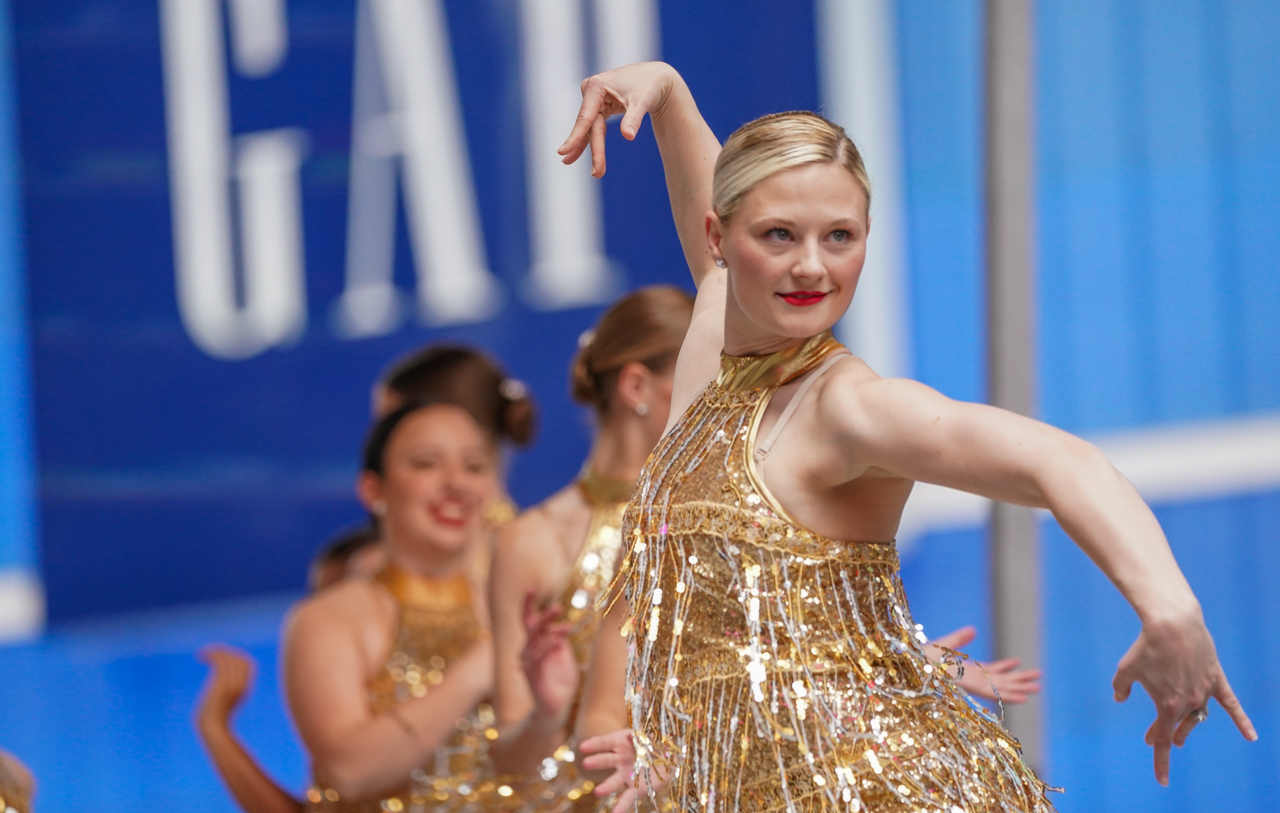
While the Carolina Snowbelles have a style that has a decidedly “Radio City Rockettes” flair, reflecting Cutlip’s 15-year career with the Rockettes in New York City, one of the unique characteristics of the outdoor, open-air event called “Project Dance” is that spectators will see polished routines styled in ballet, hip hop, modern, jazz, and tap. Many of the performances are choreographed to tell a story, many with religious themes. Others may be romantic or artistically acrobatic but all delivered entertaining fun, if not emotional or inspirational meaning. In a word, it was a beautiful event.
Photographic image by David Rogers
Audience favorites included artistic presentations such as “Swing Low, Sweet Chariot,” “Boogie Woogie Bugle Boy of Company B,” a couple of hip hop numbers, a tap routine, as well as Ava Cutlip’s jazz dance tribute to the late Chet Walker, a multi-award winning director and choreographer as well as on the faculty of the Broadway Dance Center. And, of course, there was the Carolina Snowbelles’ “On Broadway.” Every performance for the full seven hours received enthusiastic applause from the massive audience composed not just of the dancers’ friends and families, but surprised visitors and passers by alike.
All in all, there were nearly 100 performances in the six- to seven-hour dance concert.
The Project Dance Foundation is a non-profit 501(c)(3) organization with a mission of providing training, networking, education and performing opportunities for dancers worldwide. The Foundation seeks to make dance accessible to the public through outdoor/open air performances in prominent urban locations such as New York City, London, Sydney, Hong Kong and Washington DC.
“These concerts bring hope and healing to humanity and offer a positive message to those who attend,” said Cutlip as she addressed the gathered throng at 44th and Broadway. “Dancers around the world gather to encourage and support one another through training, networking and performing. Our goal is to see every dancer nurtured to their fullest human potential, and by doing so, to realize a more positive and redemptive culture of dance and entertainment for the future generations.”
For those who truly watched and listened to the dance performances and the music wrapped around them, there were emotional, spiritual, energy-charged and fun audience experiences.
BONUS RANDOM PHOTOS
Photographic image by David RogersPhotographic image by David RogersPhotographic image by David RogersPhotographic image by David RogersPhotographic image by David RogersPhotographic image by David RogersPhotographic image by David RogersPhotographic image by David RogersPhotographic image by David RogersPhotographic image by David RogersPhotographic image by David RogersPhotographic image by David RogersPhotographic image by David RogersPhotographic image by David RogersPhotographic image by David RogersPhotographic image by David RogersPhotographic image by David RogersPhotographic image by David RogersPhotographic image by David RogersPhotographic image by David RogersPhotographic image by David Rogers
Photographic image by David Rogers
Photographic image by David RogersPhotographic image by David Rogers
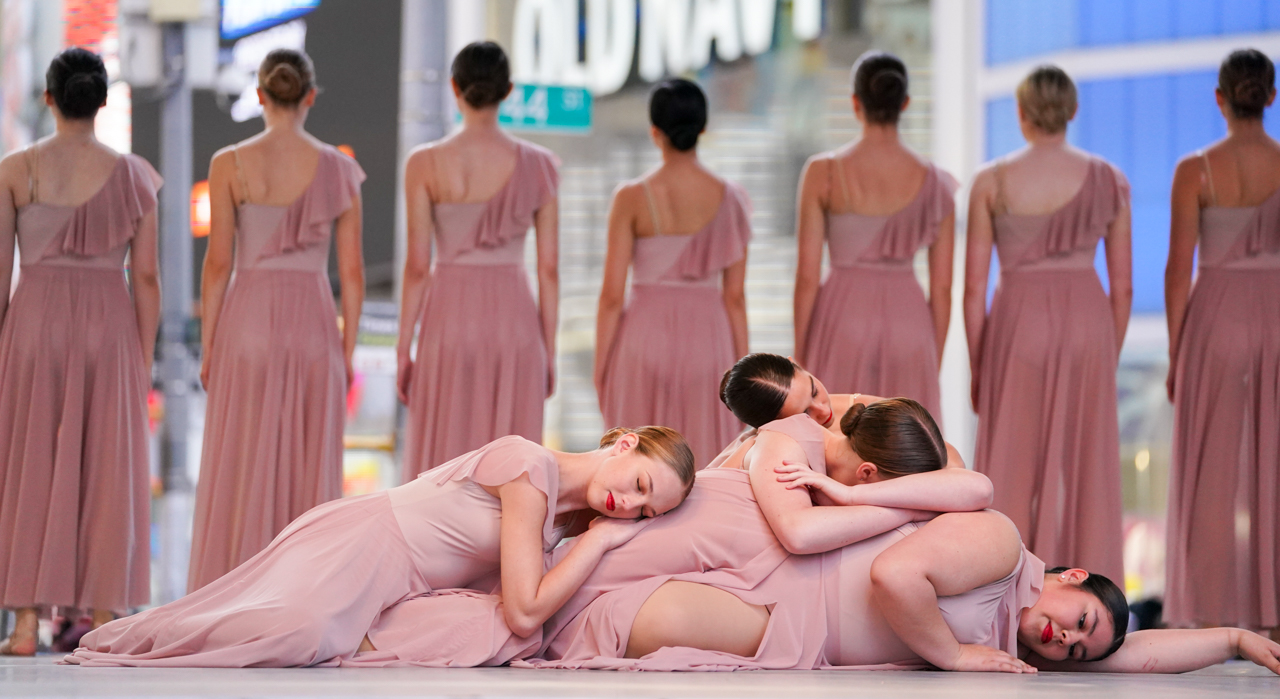
By David Rogers. NEW YORK CITY — Amidst a cacophony of urban street sounds — fire truck, ambulance and police sirens; rattling manhole covers; and a virtual cornucopia of human-made noises — the beauty, artistry, emotion, romance and inspiration of Project Dance fit right in.
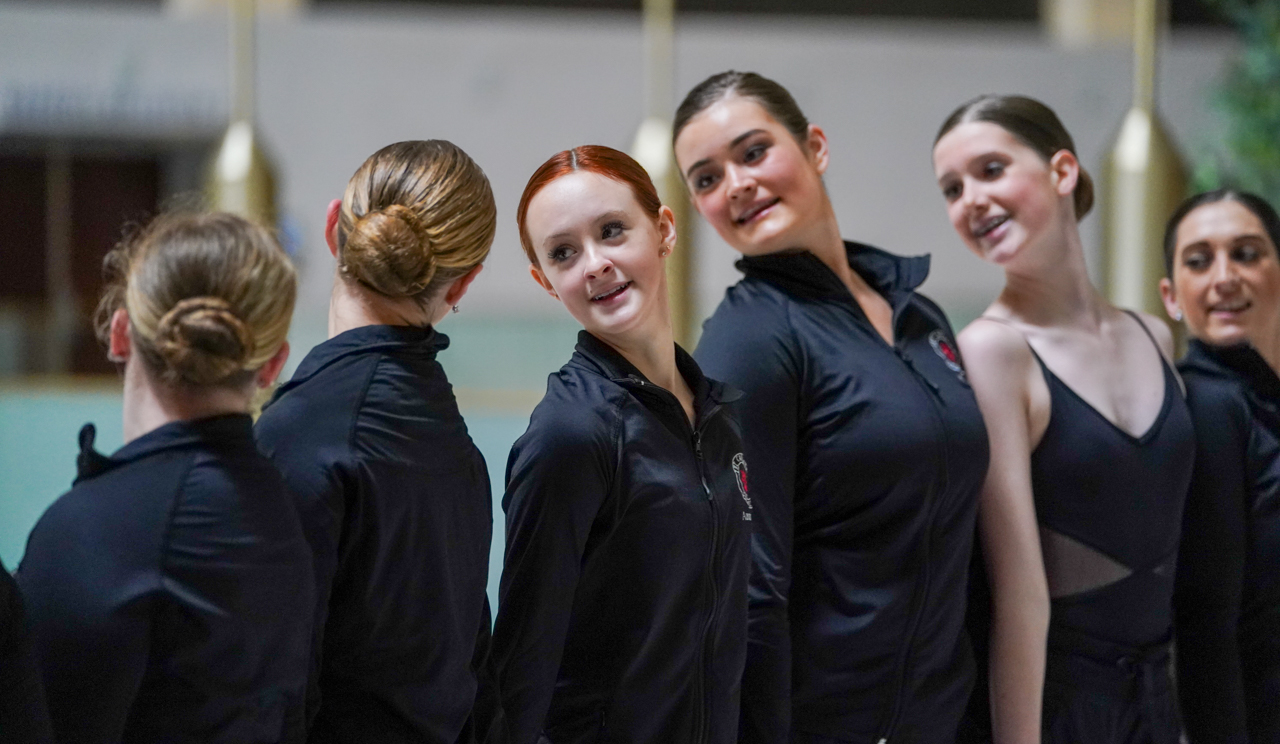
Almost 30 dance companies from all over the U.S. performed a free, outdoor and open-air dance concert for nearly seven hours on April 22. Among them: the High Country’s Carolina Snowbelles, a performance team out of The Space at Project Dance, director Cheryl Cutlip’s dance studio in Boone.
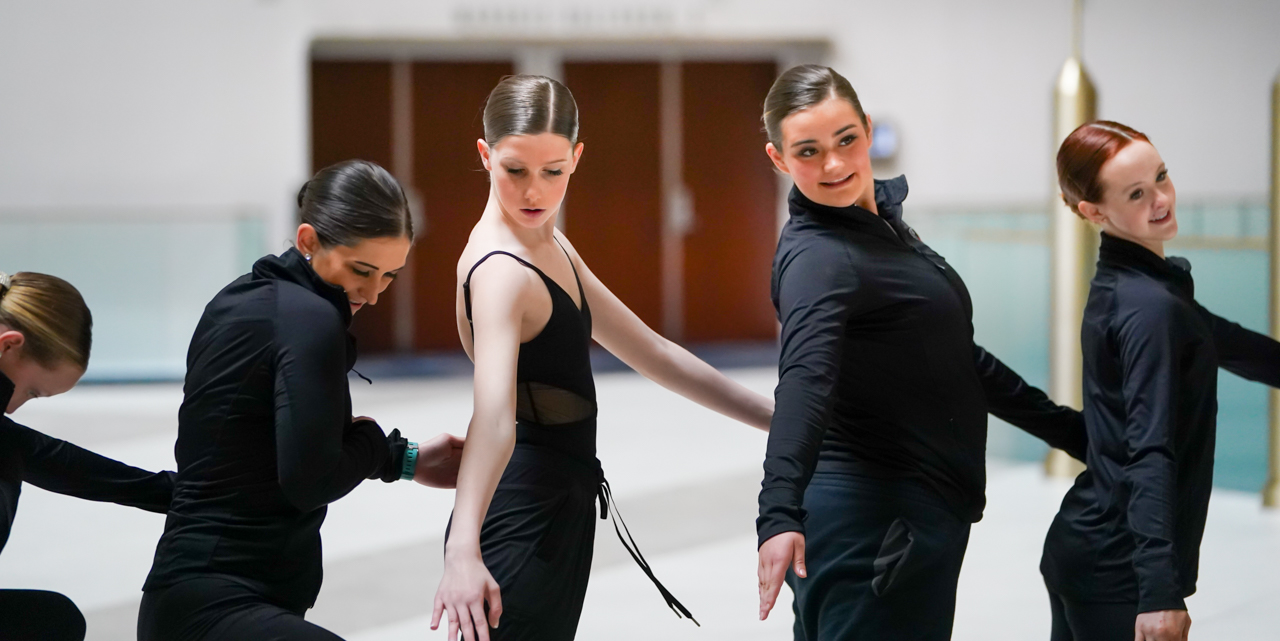
The Carolina Snowbelles rehearsing on the 9th floor of the Marriott Marquis Hotel in New York City, two hours before their live performances in Times Square for Project Dance. Photographic image by David Rogers
Cutlip, who with her husband and two teenage children call Blowing Rock home, performed with the Radio City Music Hall’s Rockettes for 15 years and, in 2002, founded Project Dance to inspire hope and healing in New York City after 9/11. She formed The Project Dance Foundation as a non-profit 501(c)(3) organization with the mission of providing training, networking, education and performance opportunities for dancers worldwide.
With over 100 free, open-air concerts to their credit in urban centers of cities like New York, Washington, D.C., London and Hong Kong — 13 countries in all, to date — Project Dance is a welcome addition to performance artistry. In short, it is achieving its mission 100-fold.
The Carolina Snowbelles had 19 members performing in New York City’s Times Square for the Project Dance event, including Cutlip and fellow instructor/director/choreographer Claudia Palta.
The Carolina Snowbelles perform ‘Dream,’ directed by Brooke Church, in Times Square, New York City on April 22 as part of Project Dance. Photographic image by David Rogers
The High Country-based group featured nine performances during the day and roughly 10 percent of the almost 100 acts.
The performances and the company members in each included:
“On Broadway,” directed by Claudia Palta, including performance members Claire Anderson, Genevieve Goff, Mallory Habich, Vera Kwong, Journey Lockhart, Ann Mellon, Skylar Moss, Cameron Parker, Luci Pedroni, Emma Pinnix, Everlie Powell, Anasofia Salinas, Maggie Schlake, Autumn Walker, Carly Watson, Avery Willingham, Rachel Witmer, Cheryl Cutlip, and Palta.
“Sing” (Tall), directed by Cheryl Cutlip, including performance members Claire Anderson, Mallory Habich, Journey Lockhart, Ann Mellon, Skylar Moss, Luci Pedroni, Autumn Walker, Carly Watson, Rachel Witmer.
“Sing” (Short), directed by Cheryl Cutlip, including performance members Claire Anderson, Genevieve Goff, Journey Lockhart, Ann Mellon, Cameron Parker, Anasofia Salinas, Maggie Schlake, Autumn Walker, Carly Watson.
“Like This,” directed by Cheryl Cutlip, including performance members Claire Anderson, Brooke Church, Genevieve Goff, Mallory Habich, Journey Lockhart, Ann Mellon, Skylar Moss, Cameron Parker, Luci Pedroni, Emma Pinnix, Anasofia Salinas, Maggie Schlake, Autumn Walker, Carly Watson, Rachel Witmer.
“Dream,” directed by Brooke Church, including performance members Genevieve Goff, Cameron Parker, Luci Pedroni, Maggie Schlake.
“Not Home Yet,” directed by Emma Pinnix, performed by Emma Pinnix.
“Won’t Let Go,” directed by Emma Pinnix, including performance members Claire Anderson, Ann Mellon, Autumn Walker, Carly Watson.
“Joyful, Joyful,” directed by Sarah Matzke, including performance members Claire Anderson, Genevieve Goff, Mallory Habich, Journey Lockhart, Ann Mellon, Skylar Moss, Cameron Parker, Luci Pedroni, Emma Pinnix, Anasofia Salinas, Maggie Schlake, Autumn Walker, Carly Watson, Rachel Witmer.
“2nd Line Live,” tribute to the late Chet Walker, directed by Ava Cutlip, performed by Ava Cutlip.
RANDOM BONUS PHOTOS
Photographic image by David RogersPhotographic image by David RogersPhotographic image by David RogersPhotographic image by David RogersPhotographic image by David RogersPhotographic image by David RogersPhotographic image by David RogersPhotographic image by David RogersPhotographic image by David RogersPhotographic image by David RogersPhotographic image by David RogersPhotographic image by David RogersPhotographic image by David RogersPhotographic image by David RogersPhotographic image by David RogersPhotographic image by David Rogers
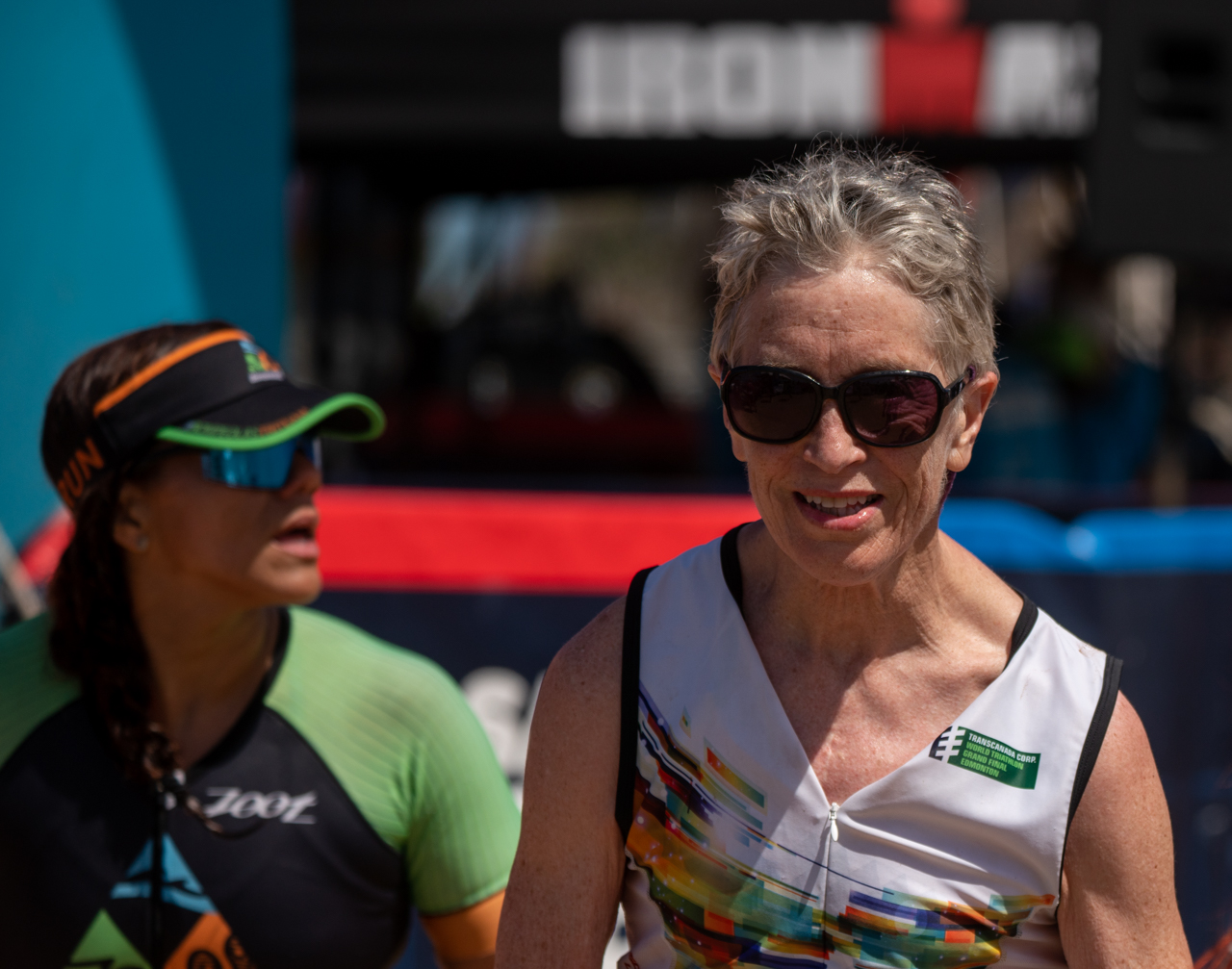
By David Rogers. BLOWING ROCK, N.C. — She has fallen down a few times and gotten slugged (accidentally) by a male competitor, but Kathy “K.B.” Medford takes it all in stride, literally. She is one of those rare athletes who reached a level of fitness (for fun) to compete in half-Ironman triathlons (AKA Ironman 70.3) — and her passion sends her globetrotting.
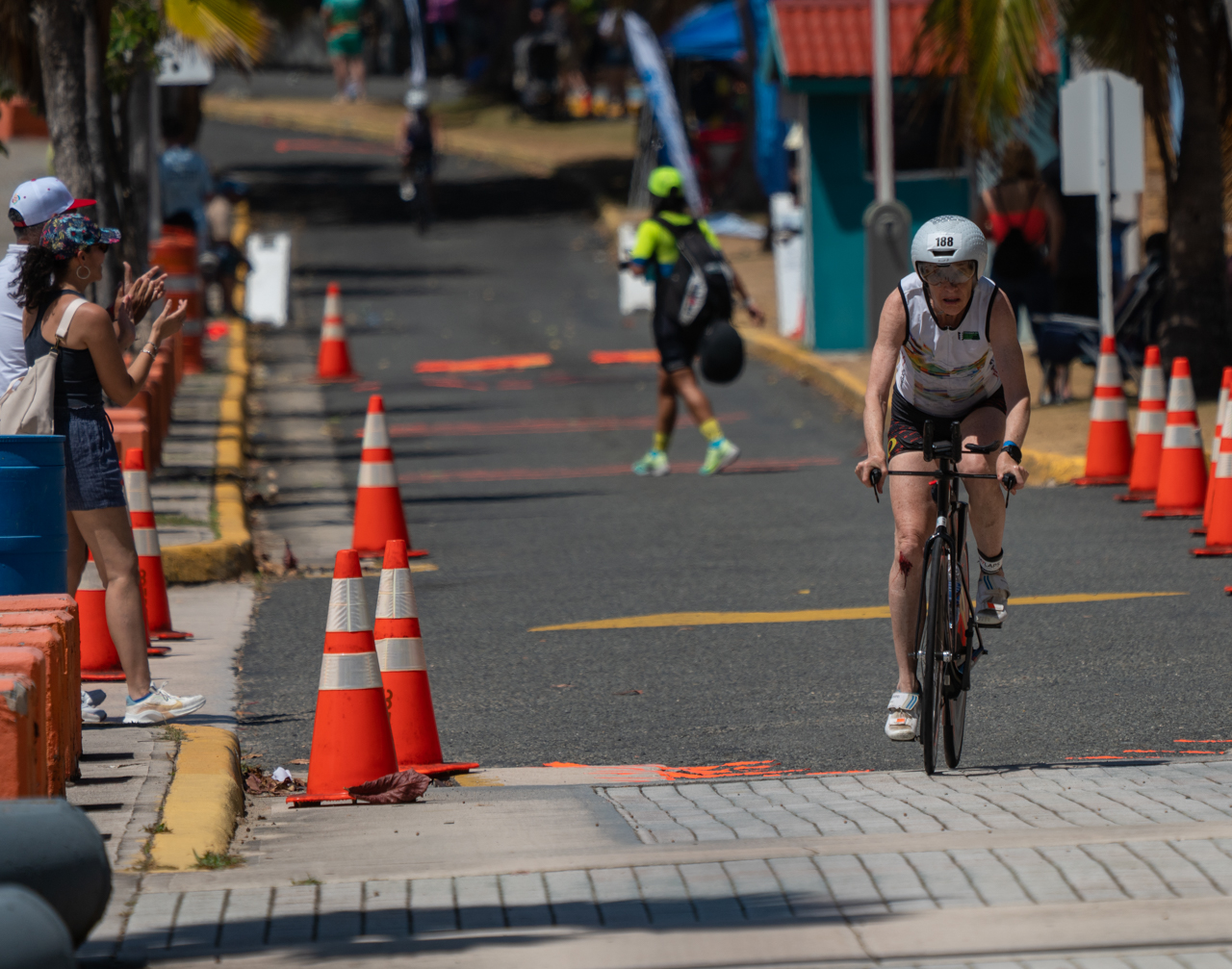
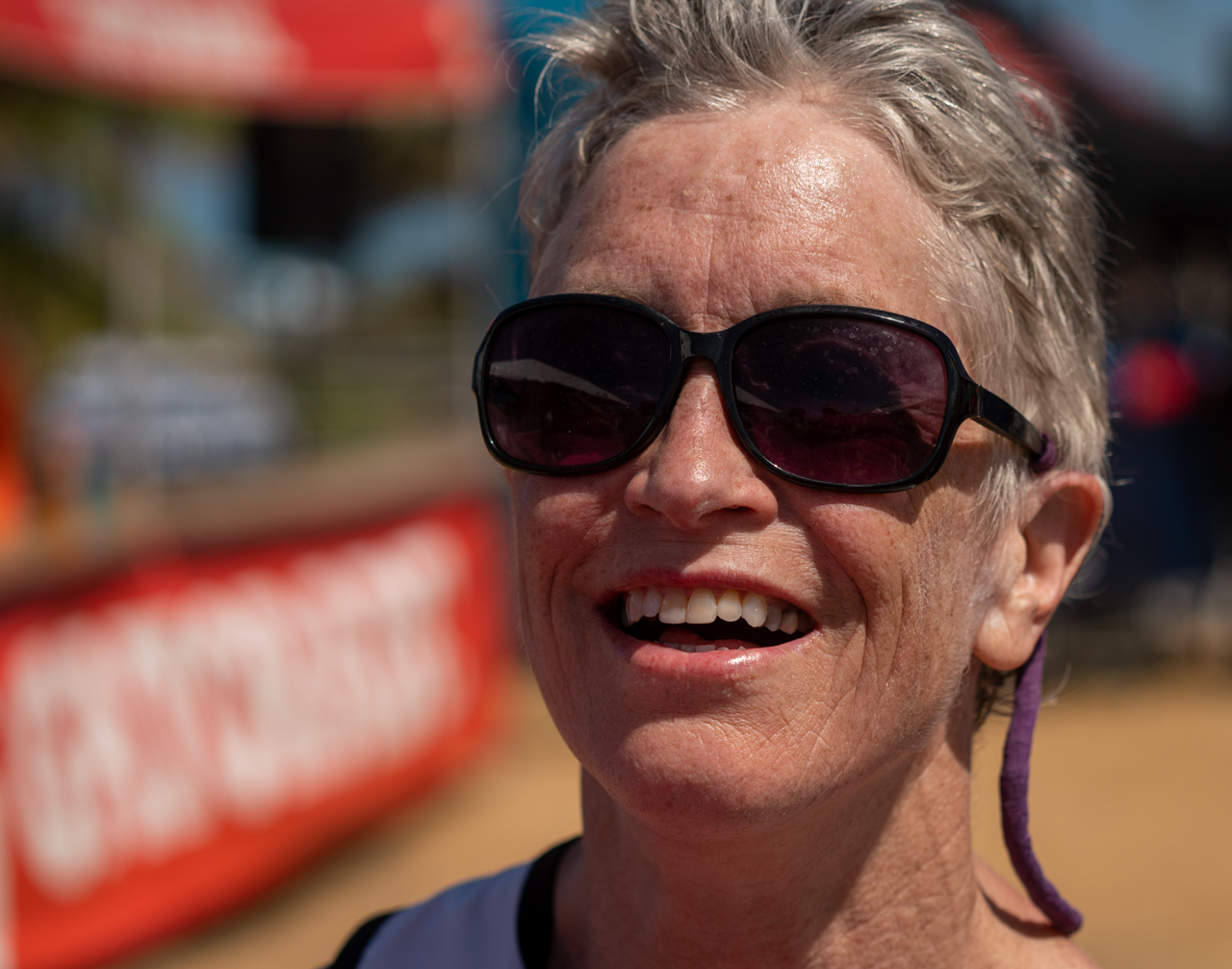
Kathy Medford in San Juan, Puerto Rico. Photo by Houck Medford
Medford will trek to Scandinavia this summer. After winning the 70+ age group for women on March 19 in San Juan, Puerto Rico, the septuagenarian set her sights on the World Championships in Finland, coming in August. It will be her third entry in the Worlds.
Ironman 70.3 is the same three athletic disciplines as the full Ironman triathlon, but exactly half the distances for each segment.
“The Half Ironman is a 1.2 mile swim, a 56 mile bike ride, a half-marathon of 13.1 miles running,” Medford explained.
In other words, it is at least a few hours of good work.
“For me, it is about six and a half to seven hours, depending on the course,” she said.
Discovering Adventure Athletics
Being an athlete came to Medford at a young age.
“I’ve kind of always been into athletic competition,” said Medford. “In high school, it was field hockey, the track team and basketball. I ended up working as a ski instructor after my first-year skiing at a resort in the Poconos of Pennsylvania, in the 12th grade.”
But Medford wasn’t just a jock. She was a student-athlete.
“After high school, I went to Penn State University, which was on a trimester system. I went spring, summer and fall, then took the winter off and taught skiing. Each spring when I came back to school I was just vibrating in the chair, studying, after being energetic and athletic all winter.”
a lot of their funding was based on how many people showed up at their first meeting!
Medford is not a stranger to competition at a high level. As a younger woman, in her college years, she became an accomplished whitewater paddler.
And it was at Penn State that Medford took up whitewater paddling.
“The Outing Club at Penn State had a really strong whitewater paddling club. They had a number of Olympic athletes. It was one of the top centers in the country for young men and women who really wanted to try and make the U.S. team for the Olympics,” Medford shared.
Photo by Houck Medford
In fact, it was one of those Olympic athletes, Carrie Ashton, who conferred on Medford her nickname, “K.B.” In 1972, Ashton was in the Olympics in whitewater paddling, kayak, and U.S. national champion for several years, Medford reported to High Country Sports in an early April, one-on-one interview at the family residence on the outskirts of Blowing Rock.
“My maiden name was Kathy Bolyn and ‘K.B.’ just stuck with my friends,” said Medford.
“The Penn State Outing Club offered a beginning class in whitewater at the beginning of the semester,” Medford said, smiling as she recalled, “They were actively recruiting students to attend the class because apparently they got a lot of their funding based on how many people showed up at their first meeting! So, they were trying to rope everybody in they could. They approached me during my first run on the university’s indoor track.”
Although the team started out with some 20 newbies at that first meeting, they ended up with only two, Mikki Sager and Medford.
“Mikki was a gymnast and built like a wedge. She was unbelievable. So Steve Draper grabbed her to race C-2 and they made the U.S. team. She was terrified the whole first year!” Medford recalled of the young woman who became one of her closest college friends — and after they had both graduated.
I went down there to thinking i would be there for a year or two. Well, i was a river person at nantahala for 20 years.
A Short Trip to the North Carolina Mountains — for 20 Years
It was Sager who gave Medford her first introduction to the North Carolina mountains and paved the way for honing her whitewater skills.
“I learned from the Penn State team as a beginner, then Mikki got a job at the Nantahala Outdoor Center in Bryson City and she called me up to say, ‘You gotta come down here. This is great!’” Medford said. “So I went down thinking I might be there a year or two. Well, I was a river person at Nantahala for 20 years. I rafted all the rivers. I kayaked. And I made the U.S. team twice, in the off years for the Olympics.”
Photographic image by David Rogers
As a kayaker, Medford also became an entrepreneur.
“A fellow showed up at Nantahala and we ended up producing a video about how to roll a kayak. Boy, that video sold like hotcakes! It ended up paying for my way through physicians assistant school after I left the Nantahala Center,” said Medford.
Medford also met husband, Houck Medford, around this time and ended up moving to Winston-Salem with him.
Back to School, and More
“I went to physician’s assistant school at Wake Forest University and then worked at Forsyth Hospital in Winston-Salem for 17 years,” Medford said.
Houck Medford deserves credit for getting his wife started in cycling, which K.B. later learned is one of the three elements of the triathlon, even if she had yet to discover what would become her athletic passion.
There was no YouTube back then, no cell phones.
“Houck was into cycling and there were a lot of local races around Winston-Salem. I took to cycling pretty quickly, too,” she said.
“We started competing in a lot of mountain bike races,” she recalled. “With a cabin in western North Carolina, we biked and biked and biked. Then Fleet Feet, a running store in Winston-Salem brought in Stacy Baties to teach running and it initially drew almost 200 people. She coached a 5k program, a marathon program, a half marathon program… dividing people up in groups of 10 or 12 who could run together at the same speed.”
But there was even more significance to the coaching, too.
“Stacy’s coaching appeared to be the same level of instruction that I received years earlier by the Olympic coaching for the U.S. whitewater team,” Medford explained. “There was no Internet or any other way to find out how to do anything, to excel at it, other than to receive personal coaching. There was no YouTube back then, no cell phones. She shared invaluable knowledge on how to train.”
Photo by Houck Medford
The Best Start
Even with her running getting better and her cycling getting better, Medford was still clueless about triathlons, but that would soon change and literally lead to a world of adventures.
“One of my physician assistant colleagues had a friend who was an MD in my department. In the past they had biked across America and shared the same adventures in triathlons. They were also competing in triathlons. I had no idea that they existed or what they were. So, one day they invited me to ‘come do a sprint triathlon with us this weekend,’” Medford recalled, before explaining what she eventually learned about the sport.
“There are four different levels of triathlon. Everyone hears about the full Ironman, which I have never done. But the half Ironman is exactly half of the full, at 70.3 miles. The Olympic triathlon distance is half of that, and the fourth level is the Sprint, which takes an hour and a half to two hours — which is kind of cute to call it a ‘sprint’!” Medford laughed.
Medford said she won her age group (then in her 50s) that very first time competing.
“Working as a physician’s assistant 50 to 60 hours a week and never having trained for a triathlon, it just didn’t seem right,” she said, with a hint of embarrassment.
But she was hooked and her friends kept encouraging her to compete in more races.
“There are professional triathletes,” said Medford, “but they are all in their 20s and 30s. Those are the men and women you read about in the magazines. The rest of us are considered ‘groupers’, competing for fun. All the manufacturers of triathlon supplies, equipment and apparel make their money off people like us.”
After her first year of competing, Medford received a letter from USA Triathlon, the organization with which all triathletes must register, telling her that she was in the top 10 percent of her gender’s age group.
I also knew I needed help.
“They said being in the top 10 percent qualified me to compete in Nationals and I said, ‘You gotta be kidding me!’” Medford laughed. “So I told Houck about it, thinking it would be fun to compete in the 2009 Nationals, which was in Milwaukee. I took 5th place in my age group in these Nationals which qualified me for the World Championships in Canada the following year.
“But I also knew I needed help, learning how to really train,” Medford added. “I found that help in a fellow by the name of Pat Rimron, who was living in Winston-Salem. He wrote out a program of what I had to do each week and it built and built and built. He got me in pretty good shape for the race in Milwaukee.”
It might well have been the Milwaukee experience that reinforced Medford’s triathlon-themed travel bug.
“It was so beautiful in Milwaukee,” added Medford. “Who would ever think it? And it was around this time that I discovered YouTube, which is where I really learned how to swim. Swimming is a highly technical skill, and the videos were very technical. Houck bought a GoPro camera, and he would film me underwater. That showed me areas where I was doing stuff not quite right. I also went down to Florida for a 4-day session on how to swim. Everyone there was a triathlete.”
Swimming in a triathlon, said Medford, is a lot different because you are competing in open water, without lane lines like in a pool — and often in water where you can’t see more than three feet in front of you.
Photo by Houck Medford
“You have to learn how to navigate,” she said. “At that time for a triathlon event, they started you in waves with 50 other women. You are bumping into each other, and some are swimming over the top of you. If the guys catch up to you, it can get worse. I have been slugged before by men, accidentally. There is a part of the stroke that is called, ‘punching the monkey,’ your arms shooting out in a spearing motion. You can’t always see and people in front of you get slugged — or people coming up from the rear might slug you!” The organizers of the triathlon have now made the swim portion much safer by starting 2-4 at a time. There are no more mass starts.”
There are beneficial differences in triathlon swimming, too, Medford discovered.
“You can draft behind someone and get up to a 30 percent benefit by swimming off of someone’s feet,” said Medford, smiling. “I have gotten pretty comfortable, though, swimming.”
So, i went to france!
Evaluating Performance
Ironically, Medford says that much of her success has come from being ‘mediocre’ in all three sports.
“Someone who trains just for one of the three disciplines, like running, may not be very good in the other two. Being mediocre or just above average in all three skills can produce a very good overall result. To me, triathlon training is so beautiful because you are never injured. There are rests between the segments when training. In the beginning you might swim, bike, and run every 3rd day. Once in a while I might do two sessions, different disciplines. You progress to where you can add hours of training and even two sports in a day.”
How many hours in a week are spent training?
“Right now, I am doing 9-10 hours a week. The professionals will train 15-20 hours each week,” said Medford. “For someone just getting into triathlons, they can do pretty well with just 4-5 hours a week. Pat Rimron paused his coaching career and I was fortunate to find Karen Buxton in Greensboro to help coach me. She has been with me now for almost 10 years. There are also many discoverable coaching plans online.”
A Ticket to Travel
Getting Medford to talk about her Ironman 70.3 experience in Puerto Rico meant also learning about France.
“I have an identical twin sister,” said Medford. “She and her husband live in New Hampshire but they go to France every year and she organizes a bicycle trip over there. They of course speak French fluently, they have studied French culture, French this and that. I have been on one of their trips and it was really nice. Well, in 2019 they were having the World Championships in Nice, France and I thought, ‘Wouldn’t it be nice if I could qualify for the Nice world championships?’ I had worked up to and competed at the half Ironman level the previous two years, so with the goal of qualifying in mind I researched the schedule of Ironman events in 2018, where you can qualify and the participant lists to determine my best shot. I determined that the Puerto Rico event was the first one in the northern hemisphere and the year before nobody in my age group competed. Well, it turned out there were seven competing in San Juan in 2019, and they were a rockin’ group of people. I did pretty well, finishing second.”
But that did not guarantee her a spot in Worlds.
“There were about 50 slots at Worlds for women and the first-place finisher at each qualifying event are guaranteed a spot,” Medford said. “That takes up about 17 spots. Then they roll down to the second and third place finishers, but usually at the younger levels where more people are competing. But that year, the women’s professionals got together with the Ironman organizers and were successful in getting more slots. As it turned out, all of the female age groups got a second place slot in addition to the first place. That’s how I got my slot in 2019, although I double qualified that year because I also competed in another qualifier, in Williamsburg, Va., and I got first place in my age group.
“So I went to France! My sister and her husband were my sherpas and took good care of me. They even got a bed and breakfast next to where the swim start was for the competition,” Medford recalled, with a smile as she reminisced. “It was a beautiful race, all the yachts and stuff. The bike segment was what they used for the Tour de France, in these huge mountains, with narrow, 2-lane roads that went down through villages that were built before cars. You are coming down the mountain really fast and all of a sudden there is a 90-degree turn on a one-lane sized road, with a brick building right in front of you! The run was pretty flat, along the Mediterranean Sea. There were 36 competing in my age group and I finished No. 10.”
there were complications in the chemotherapy, which resulted in emergency heart surgery.
Disappointments and Encouragement Along the Way
The Nice, France world championships in 2019 were not the first for which Medford qualified.
“Each venue gets the event for two years and the two years before Nice were in South Africa, which I did not compete in. But the two years before that the Worlds were in Chattanooga, the first time they had been in the U.S. in a long time. I qualified and registered to compete in 2017. Chattanooga event but I was diagnosed with breast cancer so had to get that taken care of. There were some complications with the chemotherapy which resulted in emergency heart surgery.”
The health issues did little to deter Medford’s athletic ambitions.
“The chemo was pretty rugged, but exercise helped me feel great during the day. I entered a couple of races as bald as a cue ball! That was during chemo and I still did alright. Since I had registered for the Chattanooga race I went and picked up all the goodies, but I did not compete,”
Photo by Houck Medford
Of course, the Ironman competitions were not immune to an impact by COVID-19.
“The next ones were supposed to be in New Zealand, but COVID hit, and those events were shut down,” said Medford. “The Ironman organization moved the race to St. George, Utah. I qualified and went to that one. In my age group there were 49 women competing and I finished at No. 9.
“Not everyone finished,” Medford continued. “The course was a piece of work, plus the organizers moved the women’s race from Friday to Saturday at the last minute. There was a ripple effect of problems because the airlines weren’t helping. It was costing the women an extra $800 to fly out on Sunday instead of their original departure times on Saturday. Hotels were booked. It was just a mess.
there was this rolling, black cloud of a sandstorm headed our way!
“For the race itself,” Medford added, “they moved the women’s race to 9:15 in the morning, after all of the men had raced. That really put the women in peril because the temperatures for the month before that day had been over 100 degrees. Fortunately, the afternoon temperatures were “only” in the high 90’s by race day. The temperature was about 70 degrees at the start. I got out of the water in 9th place in my age group but then had the fastest transition time, so started on the bike segment in 4th place.”
The desert challenge, though, was just beginning.
“To the organizers’ credit, they did a good job on the bike course. We rode up to a brand new, four-lane highway that had not yet been opened to public traffic. It was on a ridge top and it paralleled a lake for a couple of miles. I looked off to the left in the valley and there was this rolling, black cloud of a sandstorm headed our way! Oh my gosh! It hit with 45 mile an hour wind. The bike wanted to blow out from underneath you. Some of the ladies in front of me stopped. Others were riding tentatively with one foot out to catch themselves if the wind hit to tip them over.”
Medford was either better prepared or very lucky.
“I was being peppered with sand, but I had this visor on my helmet that if I turned my head a certain way it kept the sand out of my eyes. And I figured out that if I rode off to the side of my bike seat, I could keep the bike upright,” recalled Medford.
How long did you have to endure the sand?
“Well, the sand actually didn’t last that long, because of the hail and rain that came next!” she said. “That hurt worse than the sand! I kept looking at the road to see if the hail was going to make the road slippery with ice, but the pavement was so hot it just melted away.”
and they were all wearing garbage bags!
Meanwhile, the rain and wind kept pummeling the riders and the temperatures plummeted.
“I was getting cold as I was dressed for the 90’s, but not yet shivering,” said Medford. “I knew there was an aid station at Mile 15. I was hoping they might have garbage bags so I could fashion some makeshift outerwear. Then, a mile before I reached the aid station, the weather suddenly cleared up and it got hot.”
Laughing, Medford added, “When I got to the aid station, all the workers were down the hill picking up all the stuff that had blown away — and they were all wearing garbage bags!”
Medford said that toward the end of the bike ride there was yet another big storm, but she kept going.
“The running course was through the town of St. George and you had to run it twice to get the 13.1 miles. You had to run up a very steep section of Main Street up to a long ridge above town. It became more of a walk-run, then the coming down was so steep you could not run — and then you had to do it again. And what made it worse was by that time the temperatures were approaching 100 degrees,” said Medford in describing the last St. George segment. “I finished 9th so I was happy being in the top 10.”
However, for the following year even if she qualified, Medford said she had no ambitions for competing in St. George a second year.
“I told Houck that if I even made a squeak about competing in St. George the next year just shoot me!”
What’s Ahead
Now in 2023, having qualified for the Ironman 70.3 World Championships with her San Juan, Puerto Rico performance, Medford’s focus is getting ready for Finland, but not without a degree of apprehension.
“Finland and Sweden have applied to become members of NATO,” said Medford, morphing into an international political analyst. “Finland, of course shares a land border with the northwest region of Russia. In fact, Helsinki is only about a 5-hour drive to St. Petersburg. I just hope that Vladimir Putin doesn’t attempt to invade Finland like he has Ukraine. I know he has protested NATO’s even considering their membership. I just hope that doesn’t become an issue.”
Medford admitted to not having done much research on the World Championship courses but was confident that it would be of championship caliber.
“They have done previous Ironman competitions there,” said Medford. “It is supposed to be cold water on Aug. 26. I have a feeling it won’t be 100 degrees and we won’t have sand!”
Reflecting on her qualifying competition, in Puerto Rico, Medford said that a highlight was the number of spectators, especially for the running portion.
“They changed the course a little bit and you had to go out and back, three times. There were a lot of bars along the route to Old San Juan City, which is run by our National Park Service. It is beautiful, just gorgeous. You are running along the Atlantic Ocean and on one side it is all natural and on the other side it is all spectators. And the tourists as well as the local people were all so supportive of the athletes competing. People who I had no idea who they were, clapping and smiling and cheering. I felt like a celebrity!”
By turning 70 in January, Blowing Rock’s Medford was thrust into a new age group. Given her journey thus far, does anyone want to bet against her?
BOONE, NC – The 2023 International Fly Fishing Film Festival, sponsored by Boone’s Fly
Shop, is coming to the Appalachian Theatre of the High Country on Friday, April 21. Featuring the very best in today’s fly-fishing films, the screening includes 10 short and feature-length films. Tickets are priced at $10. Doors open at 7:00 p.m. and the film starts at 7:30 p.m. with a total running time of two hours.
The evening will include a raffle for an exclusive fly-fishing swag-pack and other prizes to suit the new or seasoned angler. Raffle tickets are $5 a piece or 5 tickets for $20 and are available for purchase at the event. Proceeds from the raffle support Watauga Riverkeeper.
Among the films in the festival are Crouching Tiger, Hidden Damsel, with oversized tiger trout, a prolific damsel fly hatch, and an obscure mountain lake; Of the Sea, brothers explore the elusive Banco Chinchorro off the coast of Xcalak; Jacks, giant trevally attacking from deep ocean water; Father Nature, a guided trip on the Snake River in Grand Teton National Park; A Slam that Saves, four species of bass found only in the Appalachians; and Dollar Dog, Atlantic salmon in Cape Breton’s Margaree River.
Others include The Focus, a story of three anglers who revisit a remote mountain stream;
Chesapeake – A Love Letter to a Watershed, the landscapes and environments of a special place; and Gold Fever, undiscovered water in the middle of the Amazon jungle.
For more information on the film festival, featured films, dates and locations, visit
flyfilmfest.com. To learn more about event sponsor, Boone’s Fly Shop, visit boonesflyshop.com. Purchase tickets by visiting either apptheatre.org or flyfilmfest.com.
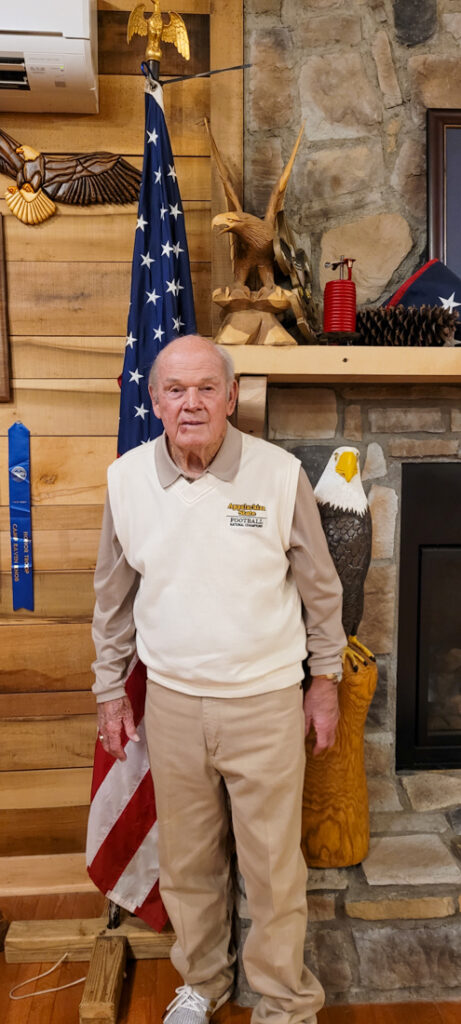
By David Rogers. BOONE, N.C. — For those who know Jerry Moore, there could be no more deserving recipient of the Blue Ridge District Boy Scouts’ very first “Good Scouting Award.” The former Appalachian State University football head coach was recognized in an April 5 ceremony at the Deep Gap Fire Department.
Former App State football head coach Jerry Moore at an earlier Boy Scouts event in Watauga County. Photo courtesy of Lee Setzer
The award was a primary feature of the organization’s Good Scouting Breakfast. The Blue Ridge District is part of the Boy Scouts’ Hickory Council. Bryan Bouboulis, the Blue Ridge District’s finance chairman, had the honor of making the presentation to Coach Moore.
“One of the first things I ever got excited about as a young kid growing up in Texas,” Moore shared with High Country Sports, “was scouting. I loved the outdoors and camping. As a Cub Scout, my Sunday School teacher was our scout Den Mother. As a Boy Scout, a local doctor was our Scoutmaster. The things they teach in Scouting are important life lessons.”
In one sense, Scouting also proved an early source of regret for Moore.
“I loved being a Boy Scout, but the things I was doing in athletics sometimes interfered. Of course I was playing football but I was also running the quarter mile in track and on the mile relay,” Moore recalled. “One of my greatest regrets is getting two badges short of being an Eagle Scout. I loved Scouting so much that when I got to Baylor, I contacted the Boy Scouts of America to see what I needed to do to achieve Eagle Scout. They told me I couldn’t. There was a hard and fast rule that you couldn’t be older than high school age, and no exceptions.”
Lee Setzer is the District executive, the paid professional with responsibilities over three counties (Ashe, Watauga and Wilkes) in western North Carolina.
“I oversee all sorts of coordination of volunteers in our scouting program,” Setzer explained to High Country Sports, “from recruiting volunteers, training, and fundraising to promotion and communications. Throughout the country and in each of our scouting districts and councils, we have these Good Scout Breakfast events. Part of the mission for these events is fundraising, but they are also an opportunity for us to recognize a local individual who represents the scouting values, whether they have been a Scout in the past or not.”
The “or not” does not apply to Jerry Moore, Setzer reported.
“This was the first Good Scout Breakfast for the Blue Ridge District, which is Watauga and Ashe counties. Jerry was a former Boy Scout in Texas, where he grew up. He got all the way to Life Scout, which is just short of being an Eagle Scout. There are a lot of boys who are Life for life.”
Setzer shared that the qualities looked for in a Good Scouting Award recipient is an individual who lives each and every day by the Boy Scout Oath and Scout Law.
The oath reads, “On my honor I will do my best to do my duty to God and my country and to obey the Scout Law; to help other people at all times; to keep myself physically strong, mentally awake, and morally straight.”
The Scout Law includes 12 points:
TRUSTWORTHY. Tell the truth and keep promises. People can depend on you.
LOYAL. Show that you care about your family, friends, Scout leaders, school, and country.
HELPFUL. Volunteer to help others without expecting a reward.
FRIENDLY. Be a friend to everyone, even people who are very different from you.
COURTEOUS. Be polite to everyone and always use good manners.
KIND. Treat others as you want to be treated. Never harm or kill any living thing without good reason.
OBEDIENT. Follow the rules of your family, school, and pack. Obey the laws of your community and country.
CHEERFUL. Look for the bright side of life. Cheerfully do tasks that come your way. Try to help others be happy.
THRIFTY. Work to pay your own way. Try not to be wasteful. Use time, food, supplies, and natural resources wisely.
BRAVE. Face difficult situations even when you feel afraid. Do what you think is right despite what others might be doing or saying.
CLEAN. Keep your body and mind fit. Help keep your home and community clean.
REVERENT. Be reverent toward God. Be faithful in your religious duties. Respect the beliefs of others.
“Our recipients exemplify these characteristics in their community and often they are giving their time to support others more so than being worried about getting something in return for themselves,” said Setzer.
At the breakfast event, the Blue Ridge District hosted roughly 20 people, including community members and scouts. Scout member Thomas Lehman spoke about his Eagle Scout project, in trail restoration.
In Watauga County, there are three “troops” of Boy Scouts, Setzer reported. Troop 100 has six members, hosted at First Presbyterian Church on Deerfield Road. Others include a similar sized Troop 160, with seven boys, organized in Valle Crucis at the Holy Cross Episcopal Church, and the largest troop in the county, Troop 109, with roughly 40 members hosted by Boone United Methodist Church.
Moore addressed the gathering after accepting the award, sharing his own scouting experience as a young boy in Texas and emphasizing the values that the experience instilled in him.
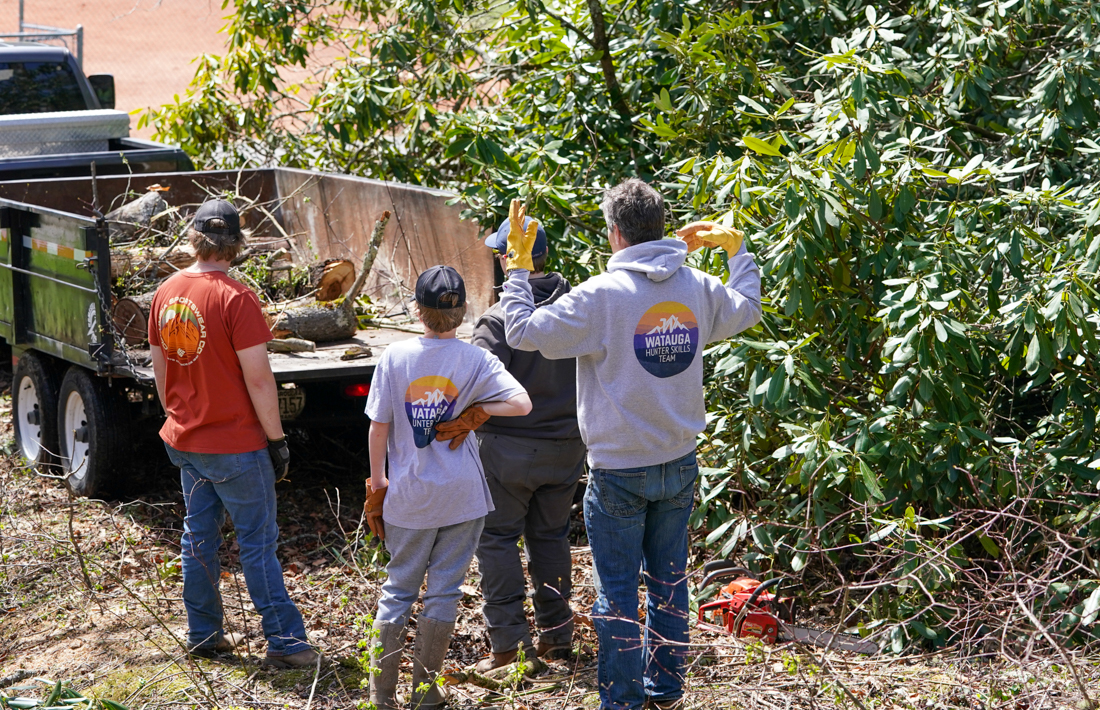
By David Rogers. BLOWING ROCK, N.C. — It may not be often that adolescent and teenage boys — as well as grownups — will give up a sunny Saturday to get hot and sweaty doing hard, physical labor for no pay. Then again, almost all in the group helping Evan Cutlip get started on his Eagle Scout community service project have already earned their Eagle Scout badges.
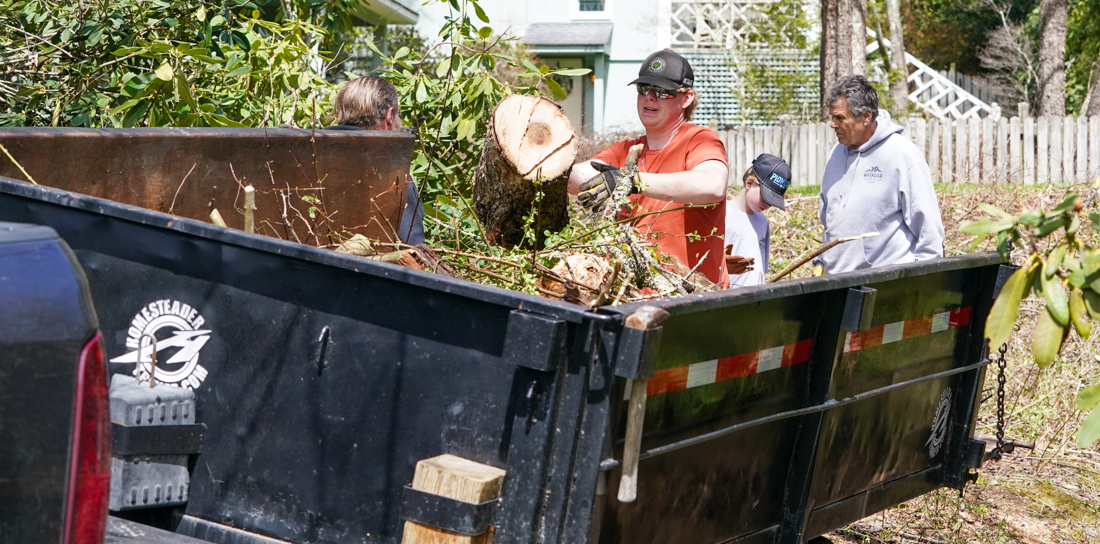
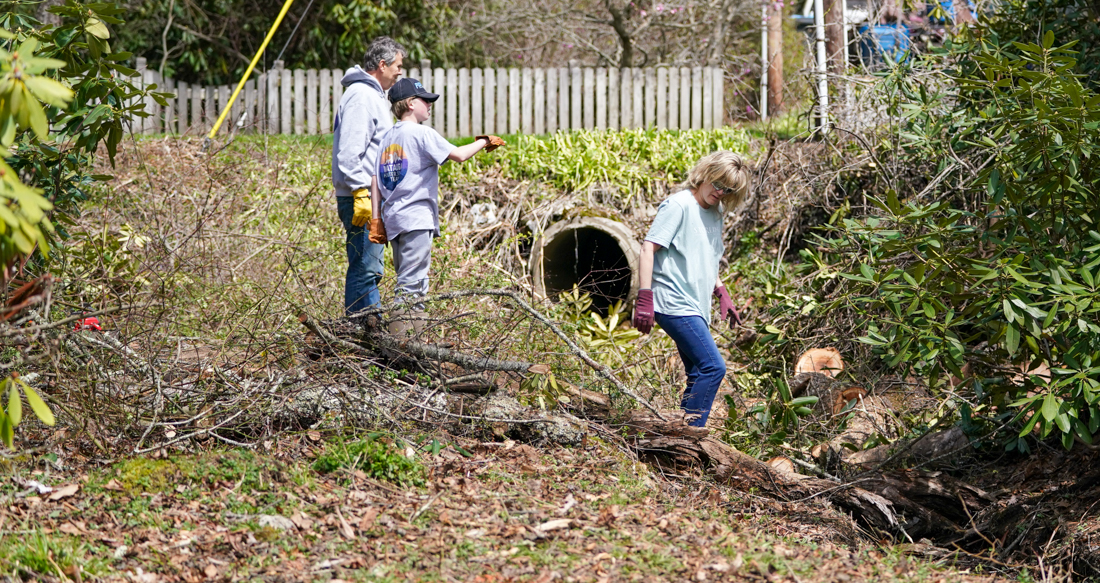
At one point, there were as many as five chainsaws buzzing in the patch of real estate between the Davant Field baseball diamond and Clark Street. Cutlip and his crew cleared out overgrown sections of rhododendron and hauled off at least five truck and trailer loads of limbs and debris while leaving all of the trees standing and most of the rhododendrons.
Cutlip’s plans are for a small, cycling “pump track,” primarily for school age kids to test their mettle on their bicycles. The Eagle Scout candidate is carving out the path with small “rollers” for skilled (and skill-learning) cyclists to increase speed without pedaling and “berms” for negotiating the curves as a community service project benefiting the town’s parks and recreation activities.
For the first work day on April 1, four Eagle Scouts, one Life Scout, as well as an Eagle Scout’s wife (Evan Cutlip’s mother, Cheryl) were there to lend a hand. Evan’s father, Ron Cutlip, earned his Eagle Scout badge in 1978, as part of Troop 264 in Brookeville/Olney, Md.
“Guys who have already earned their Eagle Scout accreditation know how important this is and are usually the first in line to help a young man hoping to earn his own Eagle Scout badge. It is a big thing, so that is why you see so these local men volunteering so enthusiastically,” said the elder Cutlip.
“I am proud of Evan and what he has already accomplished in scouting,” said Cheryl Cutlip. “Because of Ron having earned his badge a long time ago and knowing what it means to him as well as other young men setting that worthwhile goal, there is nothing I would rather be doing today than rolling up my sleeves and helping my son get the job done.”
The work crew included:
John Greene, earned his Eagle Scout badge in 2022 as part of Troop 109 (Boone)
Ben Critcher, earned his Eagle Scout badge in 2021 as part of Troop 109 (Boone)
Mike Brock, earned his Eagle Scout badge in 1994 as part of Troop 608 (Ventura, Calif.)
Ron Cutlip, earned his Eagle Scout badge in 1978 as part of Troop 264 (Brookevill/Olney, Md.)
Andrew Critcher, earned his Life Scout certification in 1989 as part of Troop 100 (Blowing Rock)
Cheryl Cutlip
Evan Cutlip, 2023 Eagle Scout candidate as part of Troop 109 (Boone)
By David Rogers. BLOWING ROCK, N.C. — The newest attraction at Tweetsie Railroad may well be the nearby Middle Fork South Fork of the New River — because that is where Dalton Mundy reeled in a whopper: a 24-inch Brown trout.
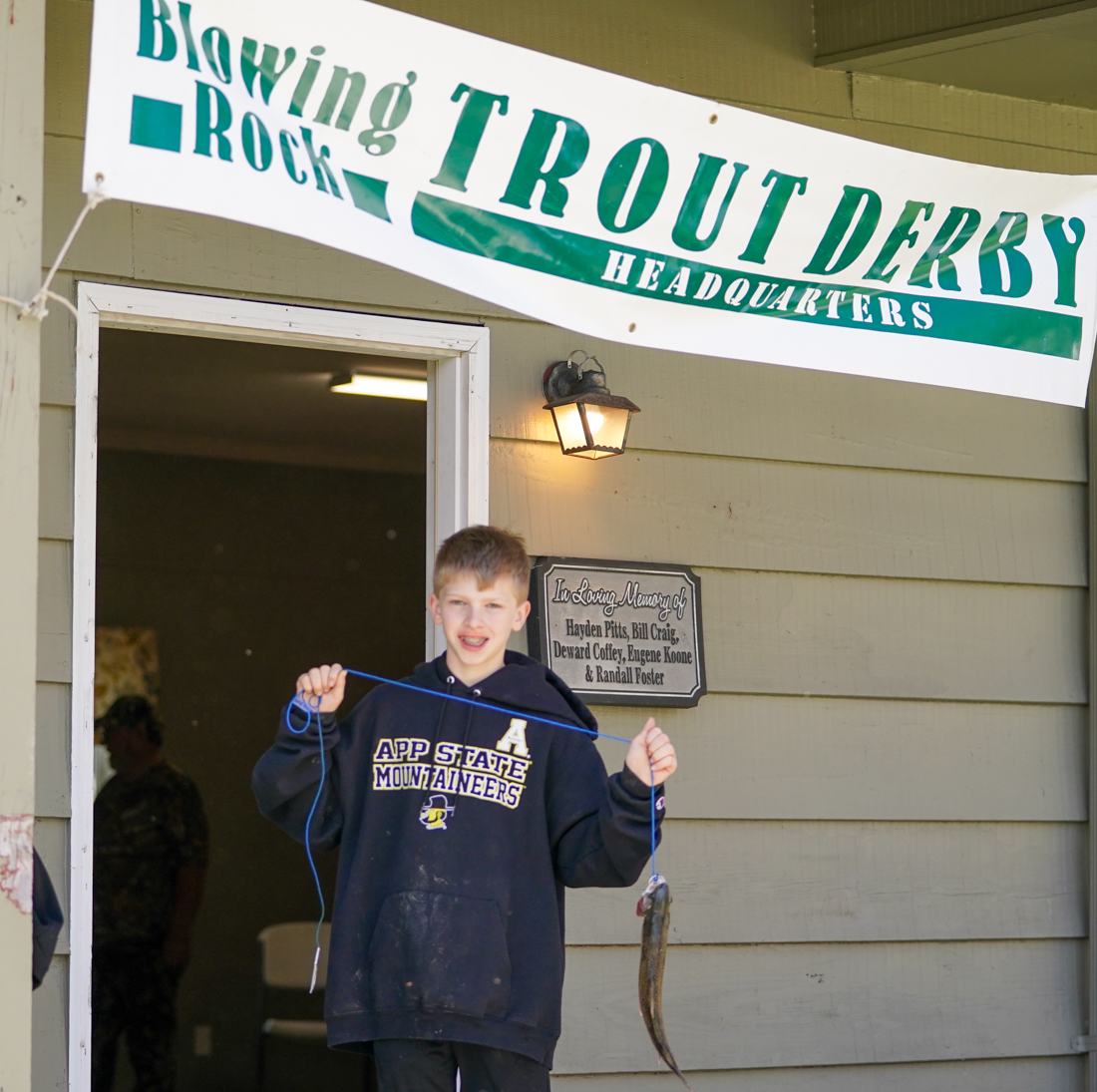
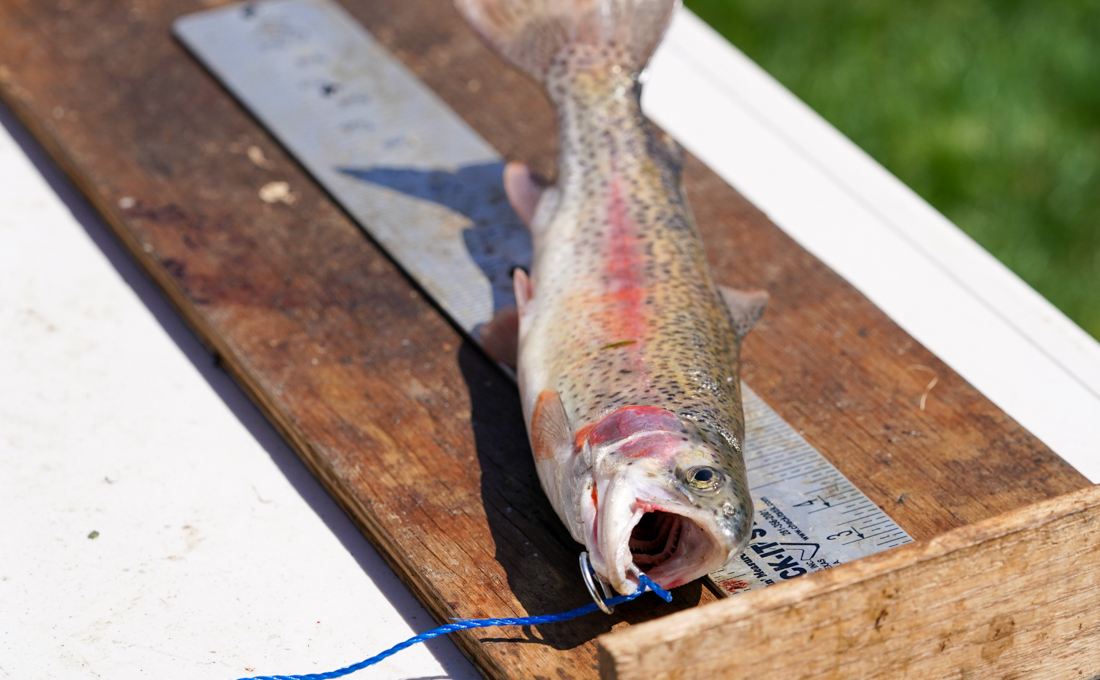
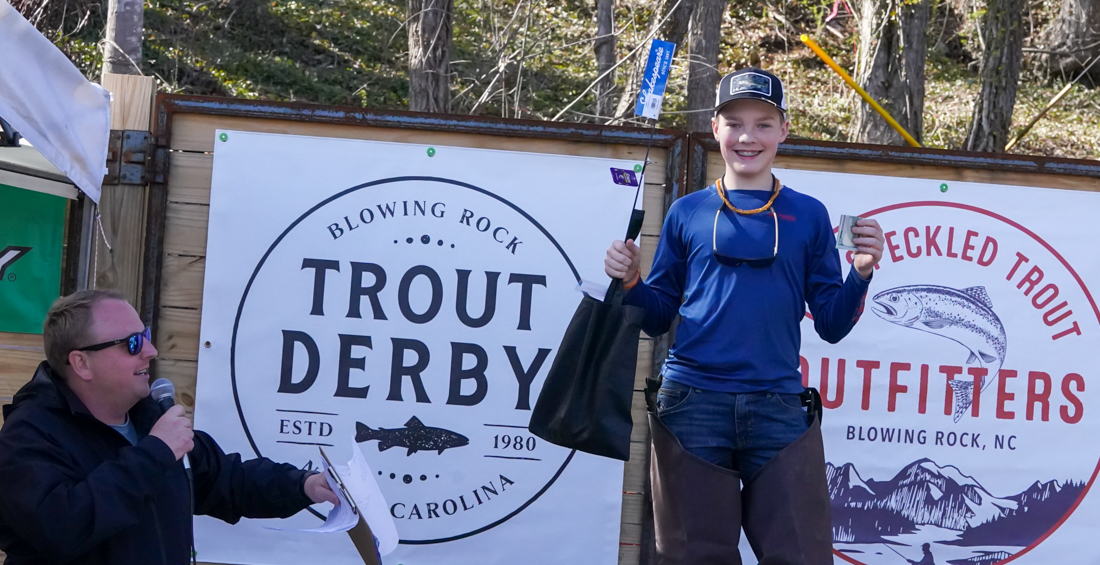
And this is not a whopper that got away tale because young Mr. Mundy registered the fish at Blowing Rock Trout Derby headquarters on April 1. He was a double winner for the 43rd annual Trout Derby event: [1] largest fish caught in the boys “harvest” division and [2] the largest by species (Brown), earning a custom made Trout Derby trophy, a bunch of fishing gear, and $100 cash.
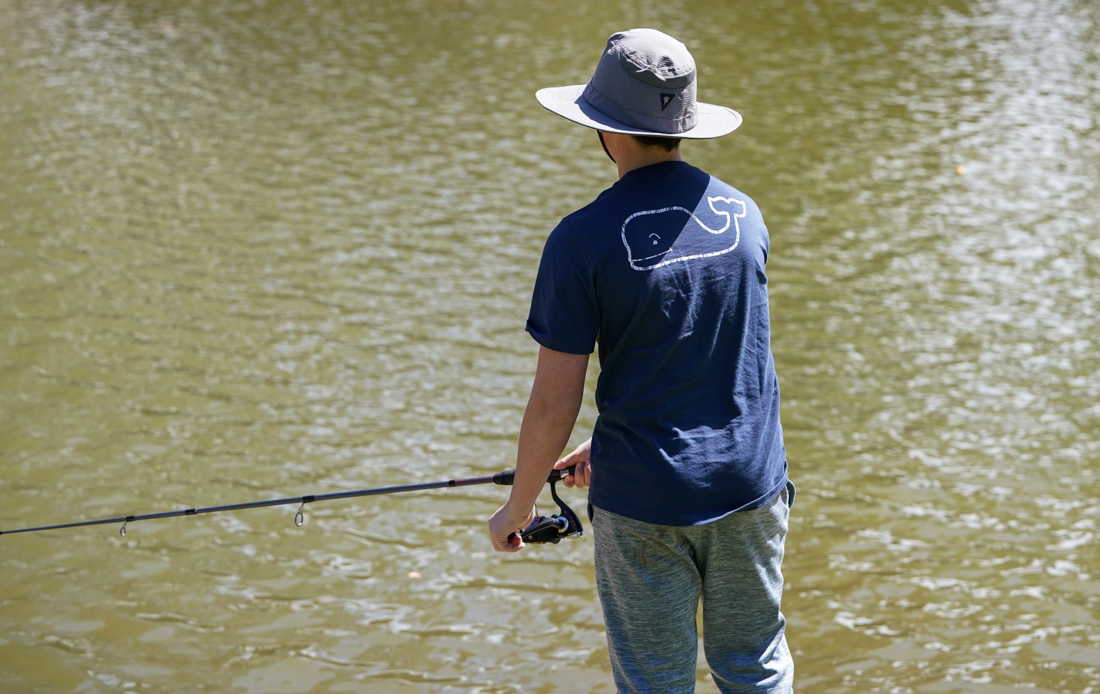
This young angler might have catching a ‘whale’ of a whopper on his mind at the 2023 edition of Blowing Rock Trout Derby, here fishing at Broyhill Lake. Photographic image by David Rogers
In the new “Catch and Release” competition hosted by The Speckled Trout Outfitters, Josh Herman ran away with the overall and Men’s Division title with what may end up being a legendary total caught (and released) during the day: 293.5 total inches of trout. When a fishing enthusiast registered for Trout Derby, The Speckled Trout Outfitters gave them a special, dated measuring device and the angler had to take a photo of each catch before it was released back into the river. Herman did not disclose his favorite fishing hole.
Something uncommon for Trout Derby this year was how late the “First Fish” caught and registered at the event headquarters, the Blowing Rock Community Club building off Clark Street. But perhaps of the early torrential rains the fish simply weren’t biting until young Renee Bolick brought in her 17-1/2 inch Brown at 8:30 a.m., from nearby Broyhill Lake. Previous years have seen the first fish award go to an enthusiast as early as 7:05 a.m., just five minutes after the season opening.
“We did see much activity early because of the rain,” explained longtime event director Kim Rogers. “As soon as the sun came out, though, it opened the floodgates. I can’t remember when we had this many people participating. We handed out 257 T-shirts by 1:00, as well as all of the 120 ‘Fish for Fun’ bags that were donated by the North Carolina Wildlife Resources Commission.”
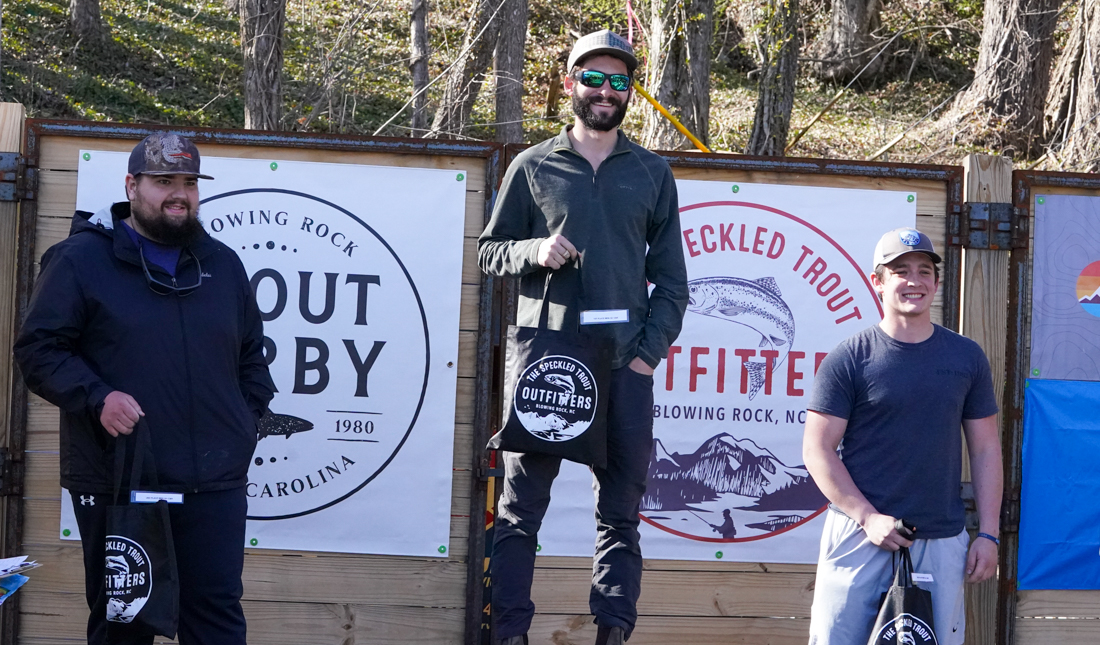
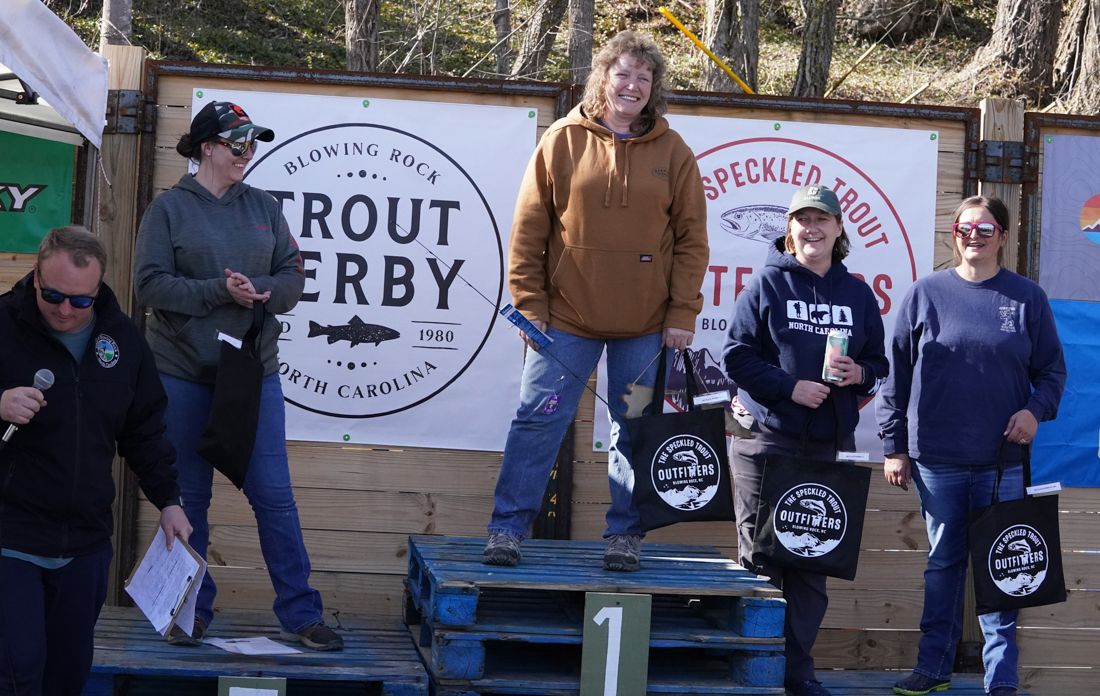
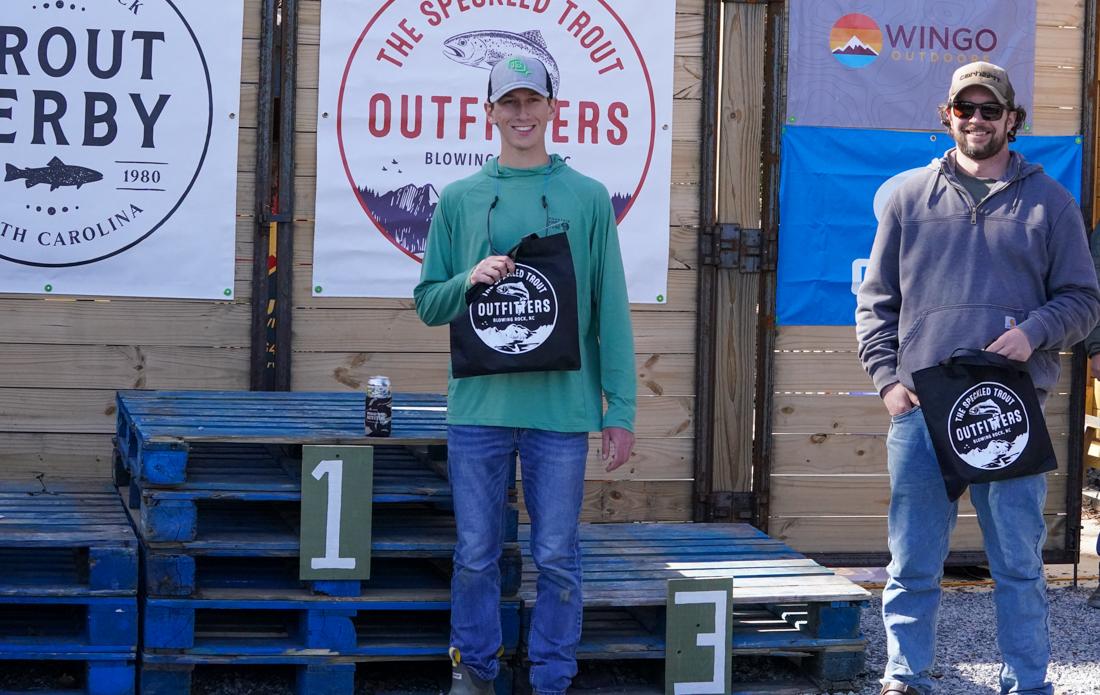
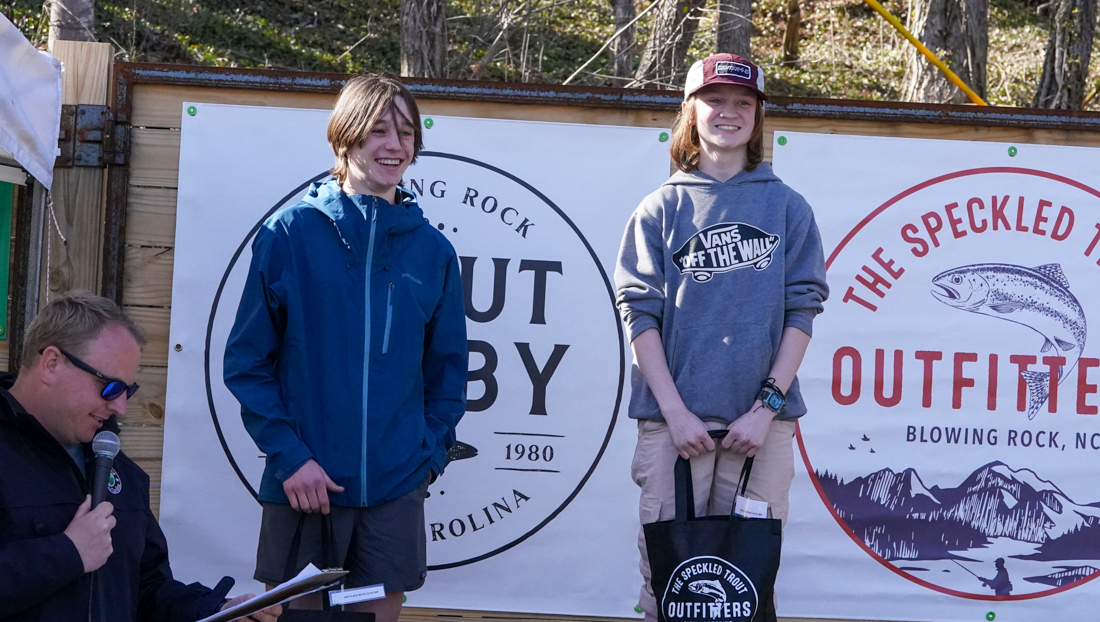
Josh Herman was kept working hard during Blowing Rock Trout Derby, with 293.5 inches caught in the catch-and-release division. He is flanked by Philip Jamerson to his right (2nd place) and Asa Nelson (3rd). Photographic image by David Rogers
Kim Rogers’ father, Elmer Jenkins, was one of four Blowing Rock businessmen who started the event in 1980 to encourage kids of all ages to get outdoors and enjoy fishing as a form of High Country recreation. Rogers volunteered (or maybe was volunteered!) to help with the event from a very early age, so it was only natural for her to take the leadership reins when her father long ago retired.
“It is great to see many of the same local people coming back year after year, making their participation in Blowing Rock Trout Derby a family tradition,” said Rogers. “We have watched young boys and girls grow into men and women with their own kids coming to fish, extending the family traditions. This year, especially, we had a larger number of new participants in both the traditional harvest division as well as in catch-and-release.”
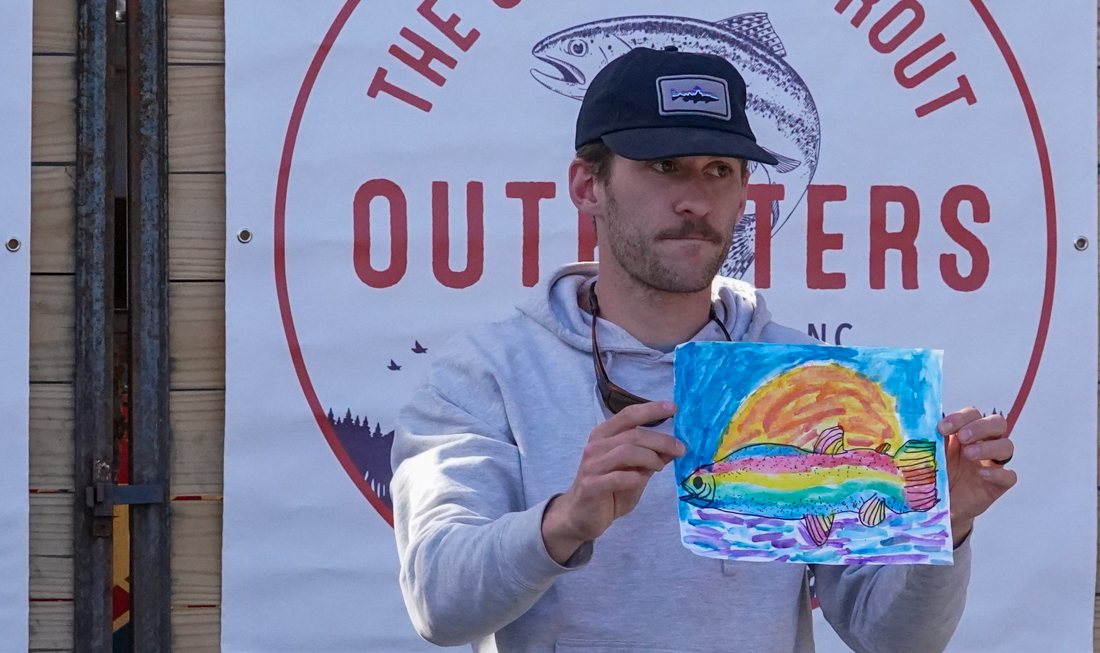
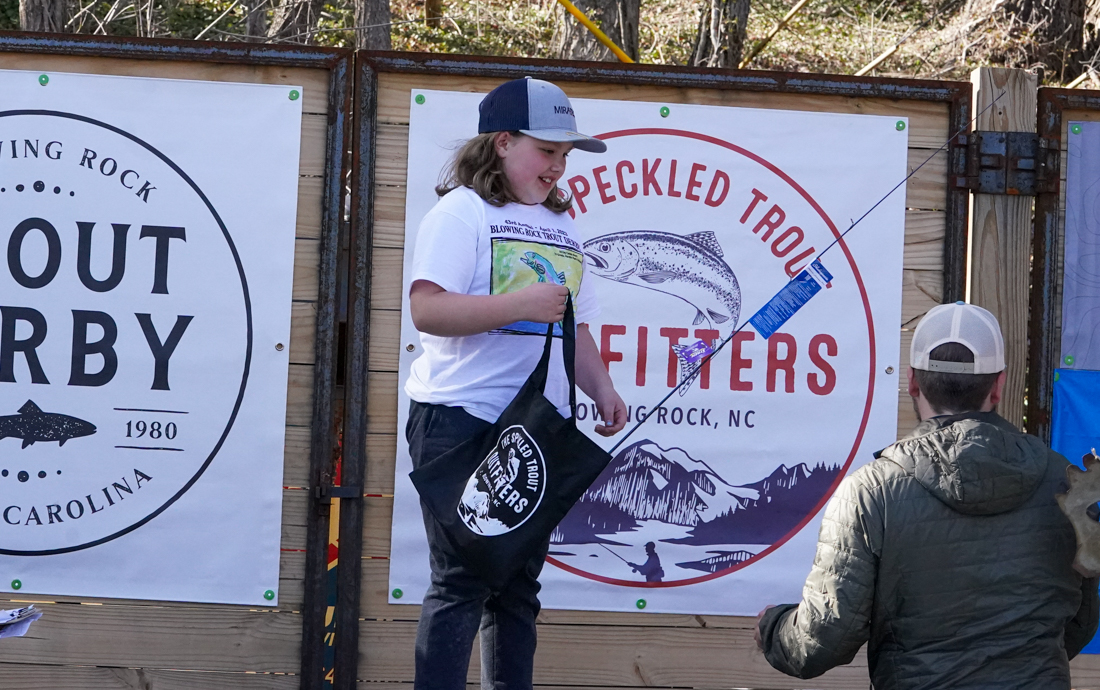
One of The Speckled Trout Outfitters employees holds up the winning art by McLean Miller of Hardin Park School. Photographic image by David Rogers
At least part of the additional interest in Blowing Rock Trout Derby in 2023 is attributed to the launch of The Speckled Trout Outfitters business and their taking a major role in organizing the catch-and-release competition.
“With the launch of the new Outfitters business we wanted continue to be involved in town,” said William Brinker, one of the owners of The Speckled Trout themed businesses. “One of our value is community, collaboration. Trout Derby is a long-standing community event. So with an our Outfitters business, this is a natural fit in helping to promote the outdoors and conservation.
“This was a great first year for us to be involved,” Brinker added. “This is the 43rd year and the folks who started it have a long legacy and we would like to carry that on. This is the first year that we introduced the catch-and-release division and I think that was a success, just trying to promote the conservation aspect of trout fishing. Catch-and-harvest is part of trout fishing heritage, too, so it is nice to be able to have a competition that allows for both.”
When advised that some people like to take their catches home for dinner, Brinker chuckled.
“That’s why we have a restaurant named ‘The Speckled Trout’! We serve trout six ways in the restaurant, so we know it is good eatin’,” smiled Brinker.
This is only about half of the art entries for the 2023 Blowing Rock Trout Derby. The judges had to cull out their favorites, then narrow down to the winners. Photographic image by David Rogers
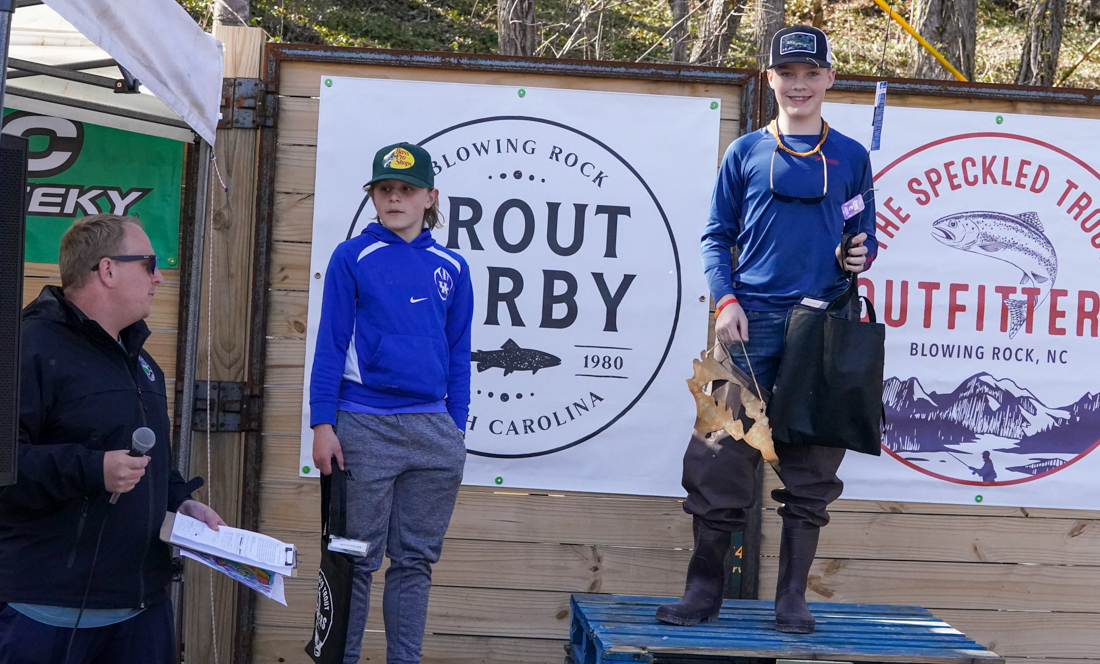
The longtime ancillary competition in Blowing Rock Trout Derby is an art contest for primarily elementary school students. The 2023 edition of the art contest included entries from at least Blowing Rock, Hardin Park, and Valle Crucis schools. Although no official numbers have been kept, the number of entries may have been the highest ever, event officials noted.
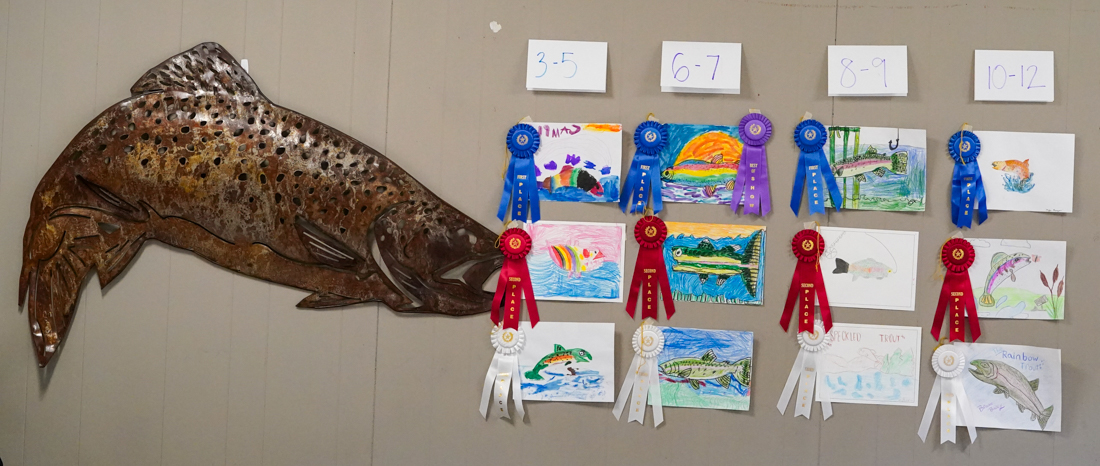
The overall winning drawing from each year’s art contest becomes the featured T-shirt and poster art for the next year’s event, with three separate age group divisions. The 2023 overall winning masterpiece was entered by 7-yearold McLean Miller of Hardin Park School. (see other winners by age group below).
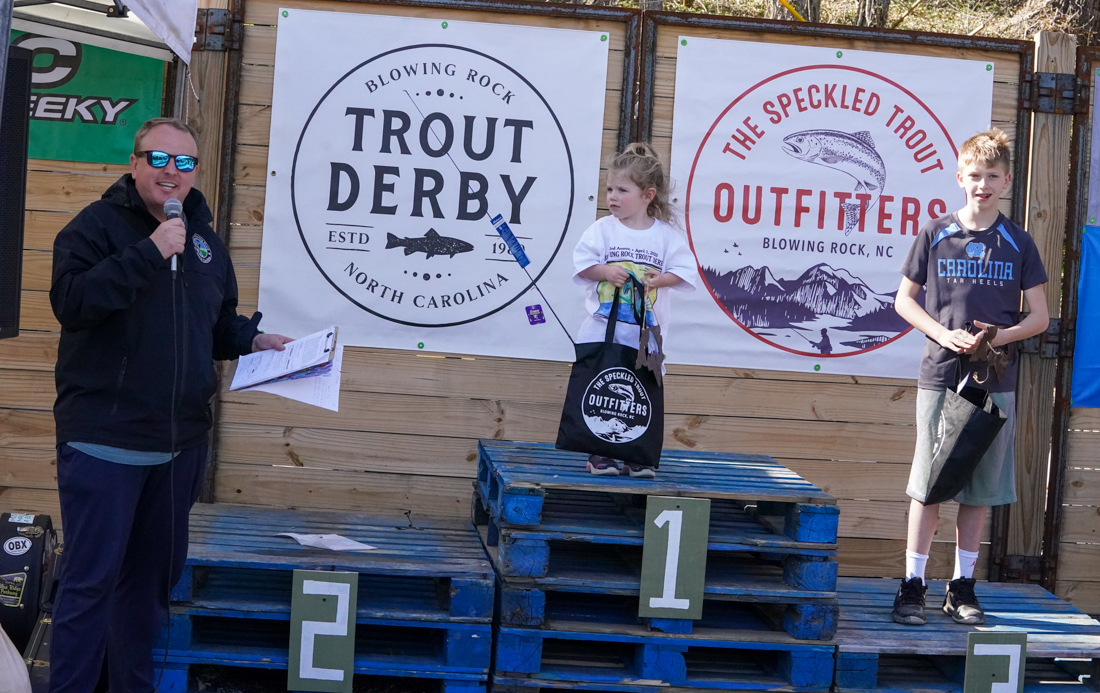
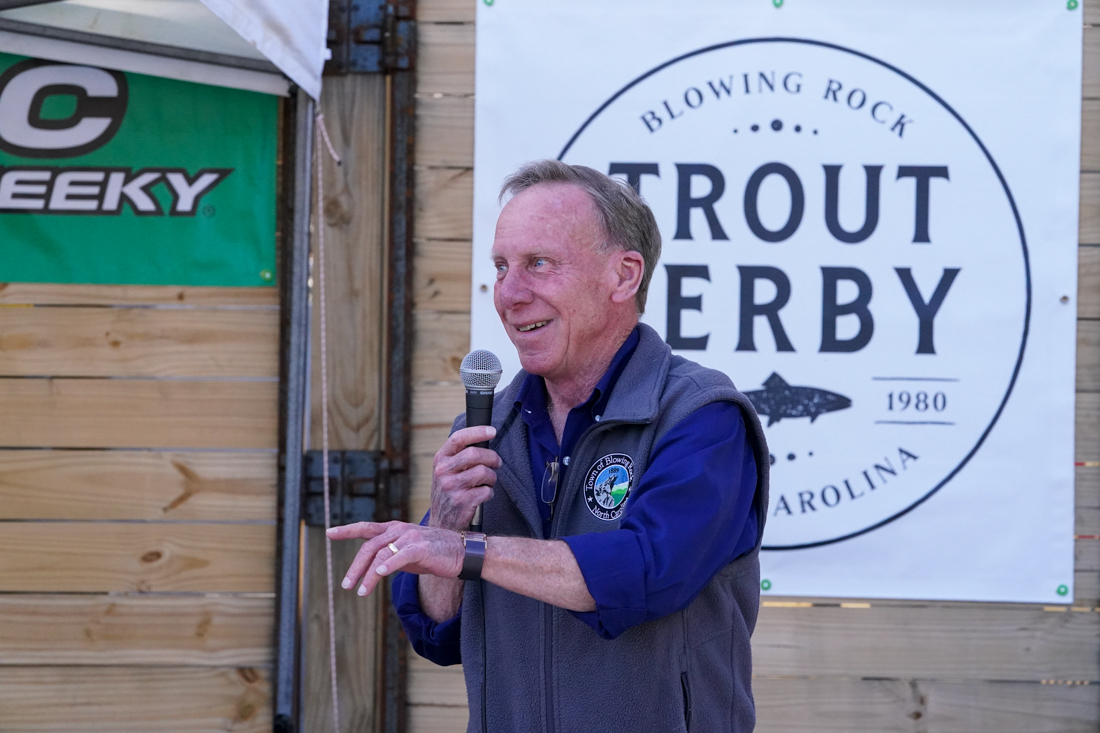
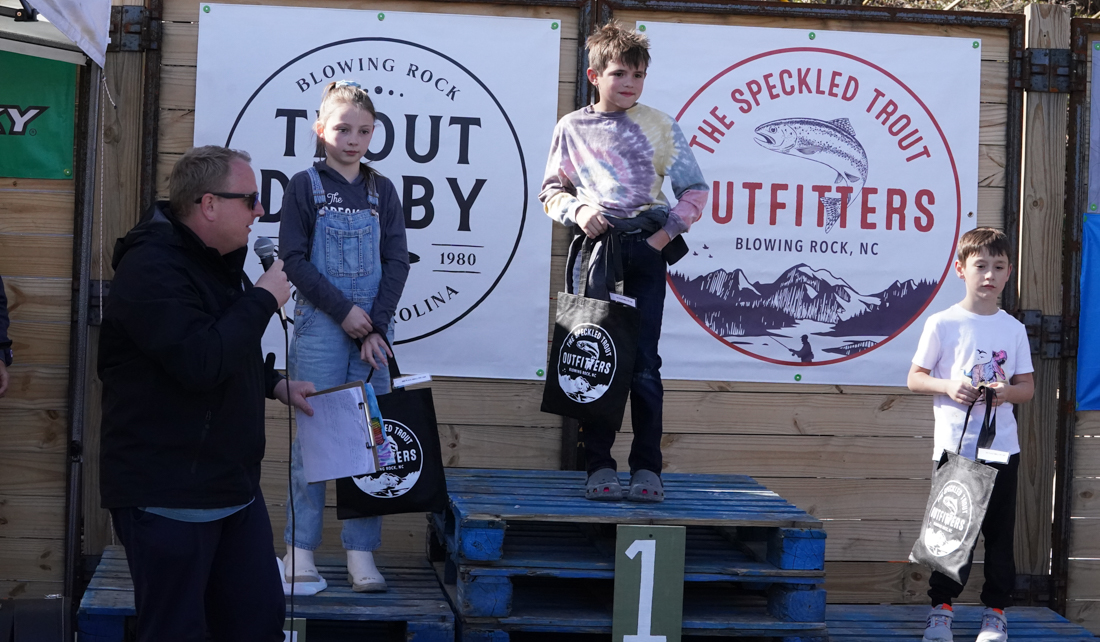
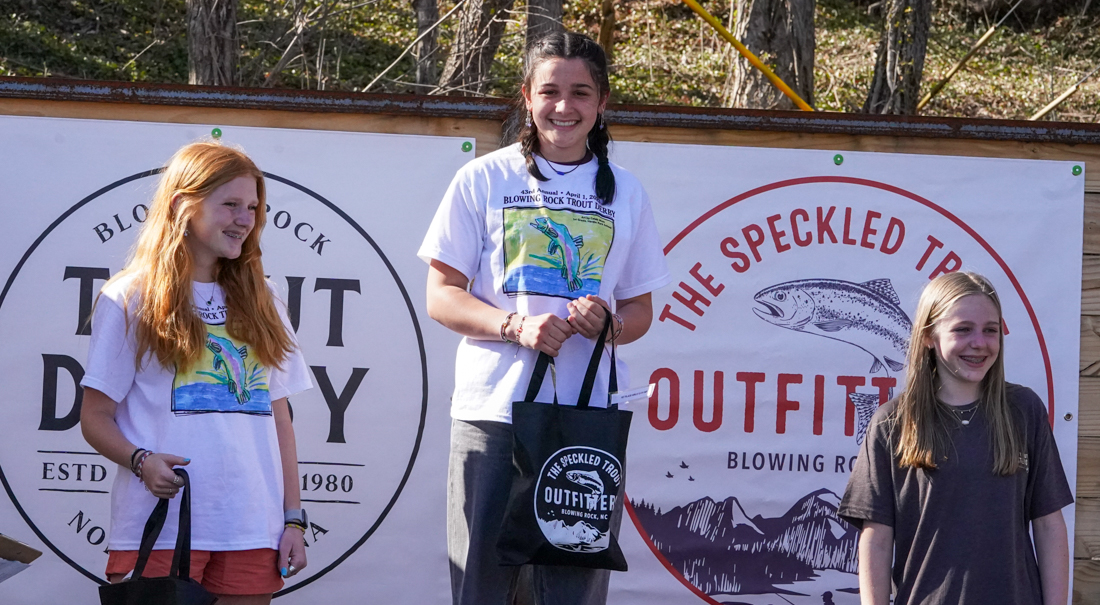
Tiny Renee Bolick (center) caught and registered the ‘first fish’ and won the Small Fry division — and just to show her versatility, was awarded 3rd place in the art contest’s 3-5 years competition. On the left is emcee Baker Stanley, Programs & Recreation Coordinator for the Town of Blowing Rock’s Parks and Recreation Department. Photographic image by David Rogers
A lot of the interest in the 2023 event may be owing to the growing number of sponsors supporting the effort. Sponsors included the North Carolina Wildlife Resources Commission’s Division of Inland Fisheries; Blowing Rock Chamber of Commerce; The Speckled Trout Restaurant, Bottle Shop and Outfitters; Jenkins Realtors; Hollars Construction; Lost Province Brewing Company; M-Prints, Inc.; Bolick and Traditions Pottery; Town Tavern; Chetola Resort; Mountaineer Maintenance; Booneshine Brewing Co.; Mike Calhoun’s Bass Club; Edmisten Heating & Cooling; Scientific Anglers; 4 Forty Four Construction; Jim Allen Home Solutions; Whitetail Properties; Snake Mountain Iron Works; Blowing Rock Ale House & Brewing Co.; A-1 Termite and Pest Control; Riversmith of Boulder, Colo.; Wingo Outdoors; NAPA Auto Parts of Boone; Temple Fork Outfitters; Costa Sunglasses; Cheeky Reels; and Mustard Seed of Blowing Rock.
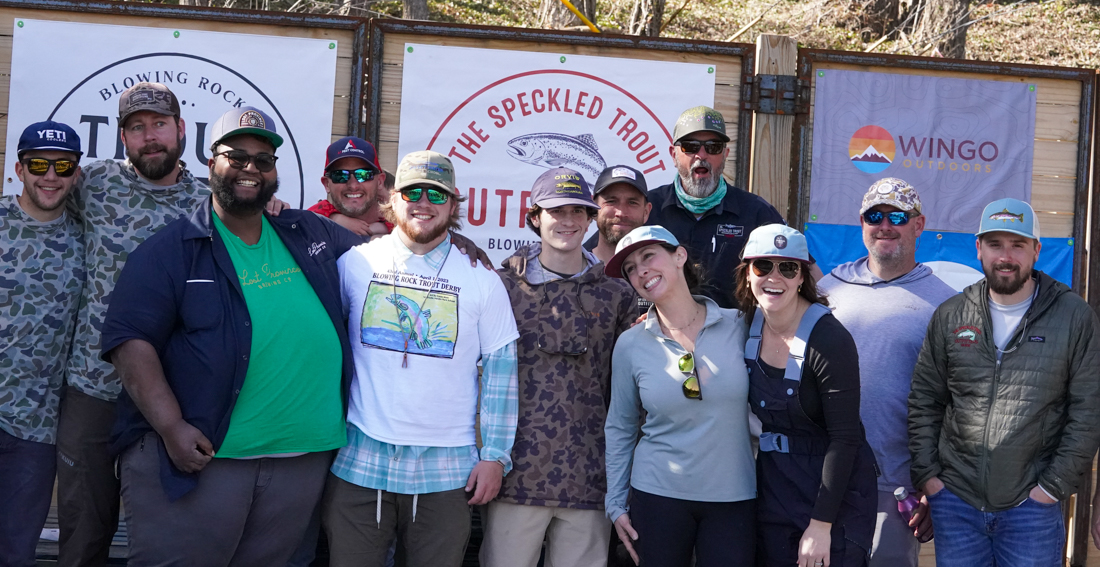
All of the first, second and third place winners were on display at the Blowing Rock Community Club building serving as Blowing Rock Trout Derby headquarters on April 1 — with the giant fish sculpture by Aaron Bishop of Snake Mountain Iron Works. Photographic image by David Rogers
The fishing trophies were sponsored by Food Lion.
WINNERS – HARVEST DIVISION
First Fish: Renee Bolick, 8:30 a.m., 17.5 inch Brown @ Broyhill Lake
Largest Trout by Species
Brook – none
Brown – 24 inches by Dalton Mundy, Middle Fork South Fork of the New River
Rainbow – 19 inches by Kevin Shaw, Price Lake
Small Fry (ages 11 and under)
Renee Bolick, 17.5 inches Brown, Broyhill Lake
Owen Jergersen, 17.25 inches Rainbow, Broyhill Lake
Nathan Byrne, 15.5 inches Rainbow, Broyhill Lake
Girls (ages 12-16)
Abigail Rich, 12.5 inches Rainbow, Broyhill Lake
Boys (12-16)
Dalton Mundy, 24 inches Brown, Middle Fork South Fork of the New River
T J Riley, 18 inches Rainbow
Coy Greer, 14.75 inches, Stony Fork Creek
Women’s
Janey Dancy, 13.25 inches Rainbow
Jennifer Triplett, 13 inch Brown, Price Lake
TIE – Carey Triplett and Pam Peine, 11 inches Rainbow