By David Rogers. CONCORD, N.C. — Kudos to the organizers of the NCRunners Middle School All-State Track and Field Championships on May 2, hosted by Jay M. Robinson High School. One hundred and forty-one (141) North Carolina middle schools were represented, including 25 Watauga District 6th, 7th and 8th graders. Watauga didn’t win any state titles this year, but when you consider that most of the events had upwards of 100 athletes competing — in each event — just qualifying to be there was an accomplishment unto itself.
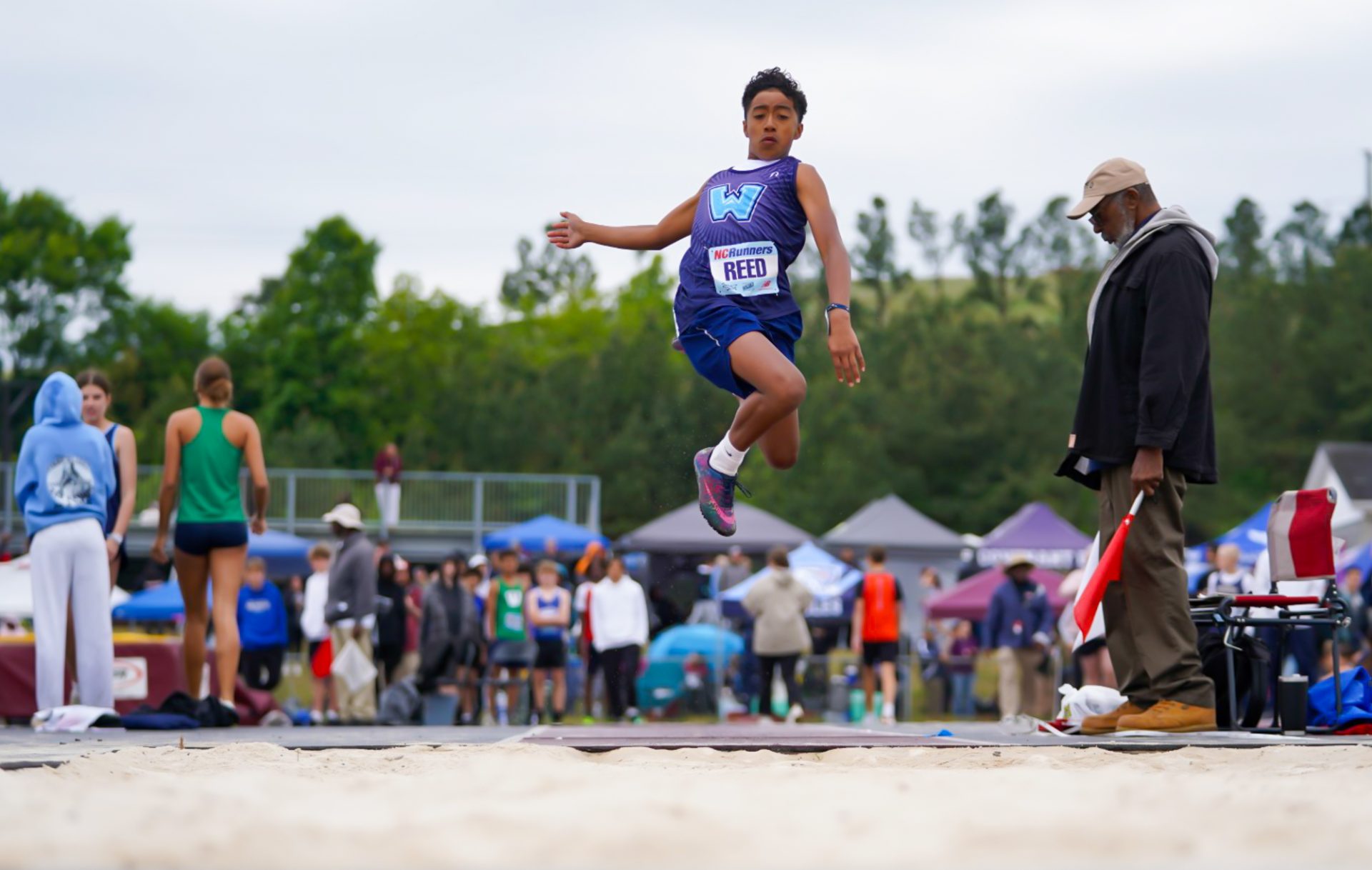
FLYING HIGH: Watauga’s Johnny Reed earned a No. 19 finish competing against 41 other middle school athletes in the NCRunners middle school state meet on May 2. Photographic image by Jared Everett for Blowing Rock News
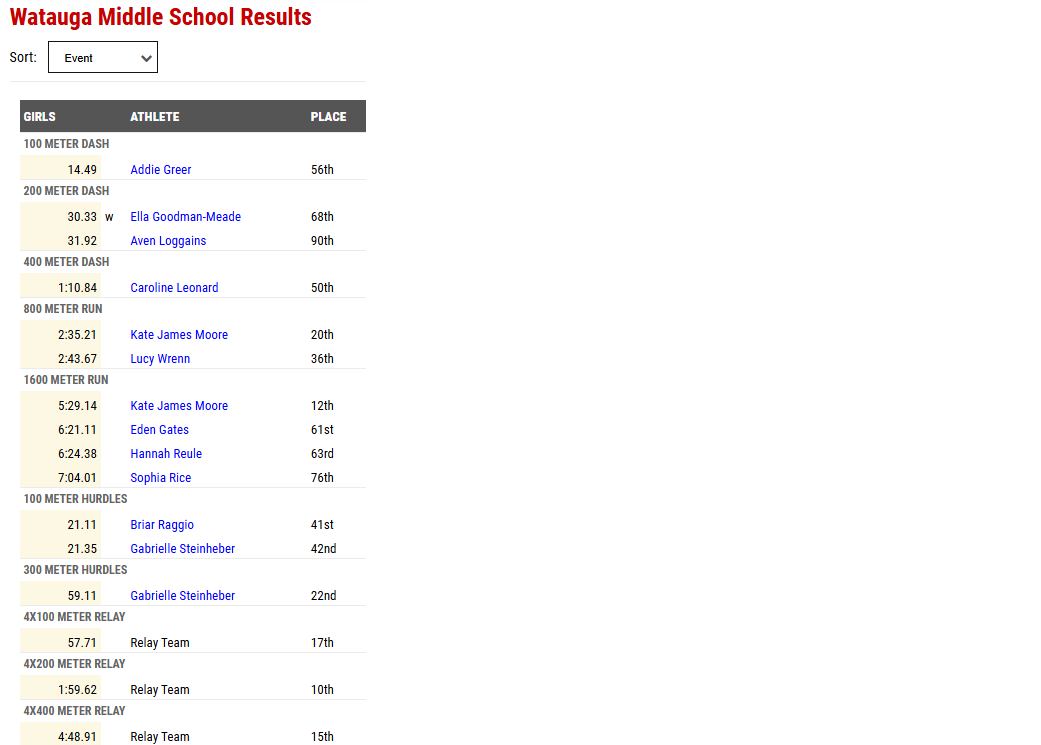
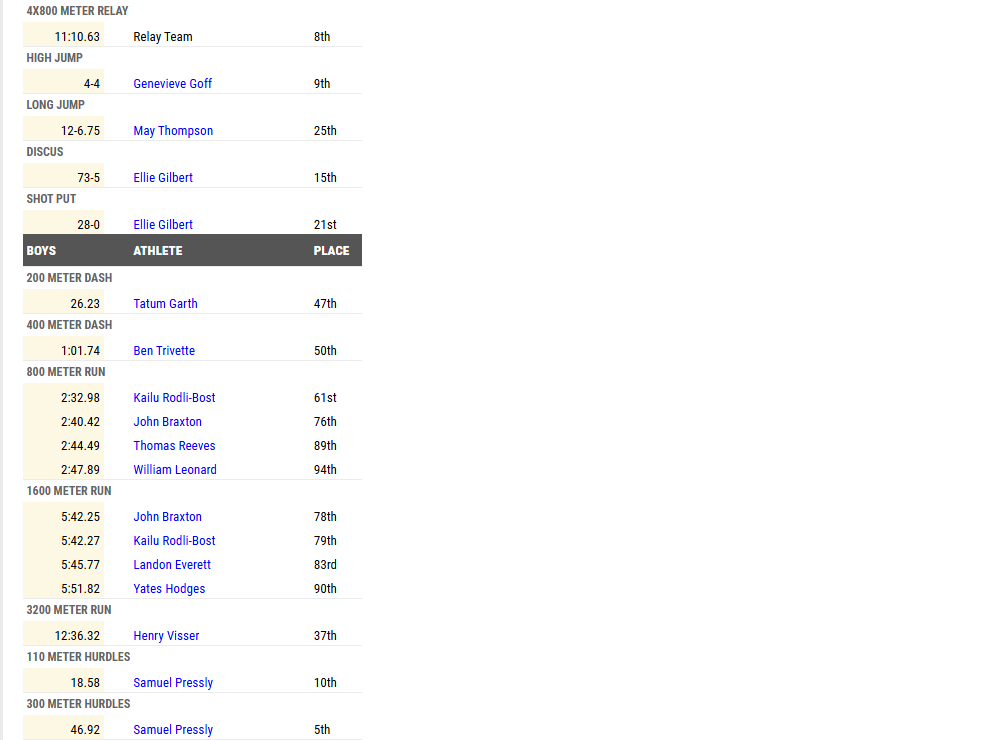
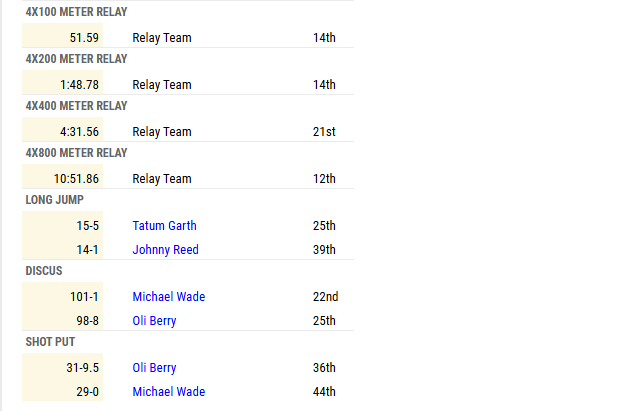
Here is a summary of the Watauga performances. The meet did not distinguish between the grade levels, so 6th graders were competing against 7th and 8th graders.
By David Rogers. TAYLORSVILLE, N.C. — With the NCHSAA 6A Regionals just two Saturdays away, May 9 at Asheville’s A.C. Reynolds High School, the Watauga men’s and women’s track and field teams had quite a “tune-up,” both claiming Northwestern Conference team championships on April 29 at Alexander Central High School — in dominating fashion.
WOMEN’S DIVISION
TEAM STANDINGS
Watauga (278)
Alexander Central (174,5)
South Caldwell (68)
St. Stephens (65)
Freedom (63.5)
McDowell (35)
We have to lead this accounting of the Watauga women’s team performances with a nod to sophomore Cali Townsend and freshman Josie Mayo.
Townsend competed in the 1600 Meters, the 3200 Meters, winning both long distance races. Josie Mayo? All she did was run on the winning 4×800 relay team, come in No. 2 in the 3200 Meters and No. 2 in the 1600 Meters.
“We call Josie’s 3-race performance ‘The Trio of Death’ because of how demanding it is to compete in those three distances in a single track event. The only ones to do it have been Josie (‘our FRESHMAN!’) and Cali,” said Watauga running coach J. Scott Townsend.
The Watauga women won each of the four relays, the 4×200, the 4×100, the 4×800 and the 4×400. In the individual events, the greatest curiosities were when the Pioneers didn’t have all three of their entries in the top five, if not a 1-2-3 sweep. The 4×800 Relay started this off, with Watauga finishing No. 1 (10:46.13), roughly 28 seconds ahead of second place St. Stephens (11:14.38).
Watauga had only two entries in the Women’s 100m Hurdles, going 1-2 with Tessa Buchanan (No. 1, 15.47) and Grace Scantlin (No. 2, 17.70). The Pioneers didn’t make the podium in the Women’s 100 Meters, but all three entries finished in the Top 10, including Charlotte Rosenbalm (No. 5, 13.45), Sophia Kop (No. 7, 13.64) and Gracyn Phelps (No. 9, 13.70). Malayah Adams of Alexander Central won the race with the only time under 13 seconds (12.39), but the rest of the field was tightly bunched with 10 runners between St. Stephens’ Ady McHenry (No. 2, 13.23) and McDowells Azmond Carson (No. 11, 13.97)
It was an exciting start to the afternoon’s competition. The Women’s 4×800 Relay could well have been the most exciting event of the day with No. 1 Watauga (1:49.29) barely edging out No. 2 St. Stephens (1:49.49). When you consider that each athlete on a team ran the equivalent of a half mile and the total distance run by each team was the metric equivalent of two miles, to have the finish come down to two-tenths of a second is a thrilling race. The Watauga foursome was Sydney Townsend, Lainey Johnston, Lily Kimbrough and Josie Mayo.
Cali Townsend continued her season-long excellence in the 1600 Meters event, finishing No. 1 (5:41.29), just over eight seconds ahead of the Pioneers’ Josie Mayo (No. 2, 5:50.23) and another three seconds ahead of teammate Lily Kimbrough (No 3, 5:53.73). The Pioneers’ 1-2-3 sweep was a statement as the only athletes under six minutes. No. 4 went to McDowell’s Elyse Foster (6:32.97).
In the 100m Hurdles, the first individual event, Tessa Buchanan and Grace Scantlin got Watauga off to a promising start with a 1-2 sweep of the event, Buchanan at No. 1 (15.47) and Scantlin at No. 2 (17.7).
The Pioneers may not have had any sprinters among the leaders in the individual 100 Meters sprint race, but apparently they have greater roster depth than the rest of the conference because they took the 4×100 Meters Relay (51.41), again by an eyelash over the runner up team, Alexander Central (51.63) for an exciting finish. Watauga’s quartet was comprised of Gracyn Phelps, Tessa Buchanan, Sophia Kop and Charlotte Rosenbalm.
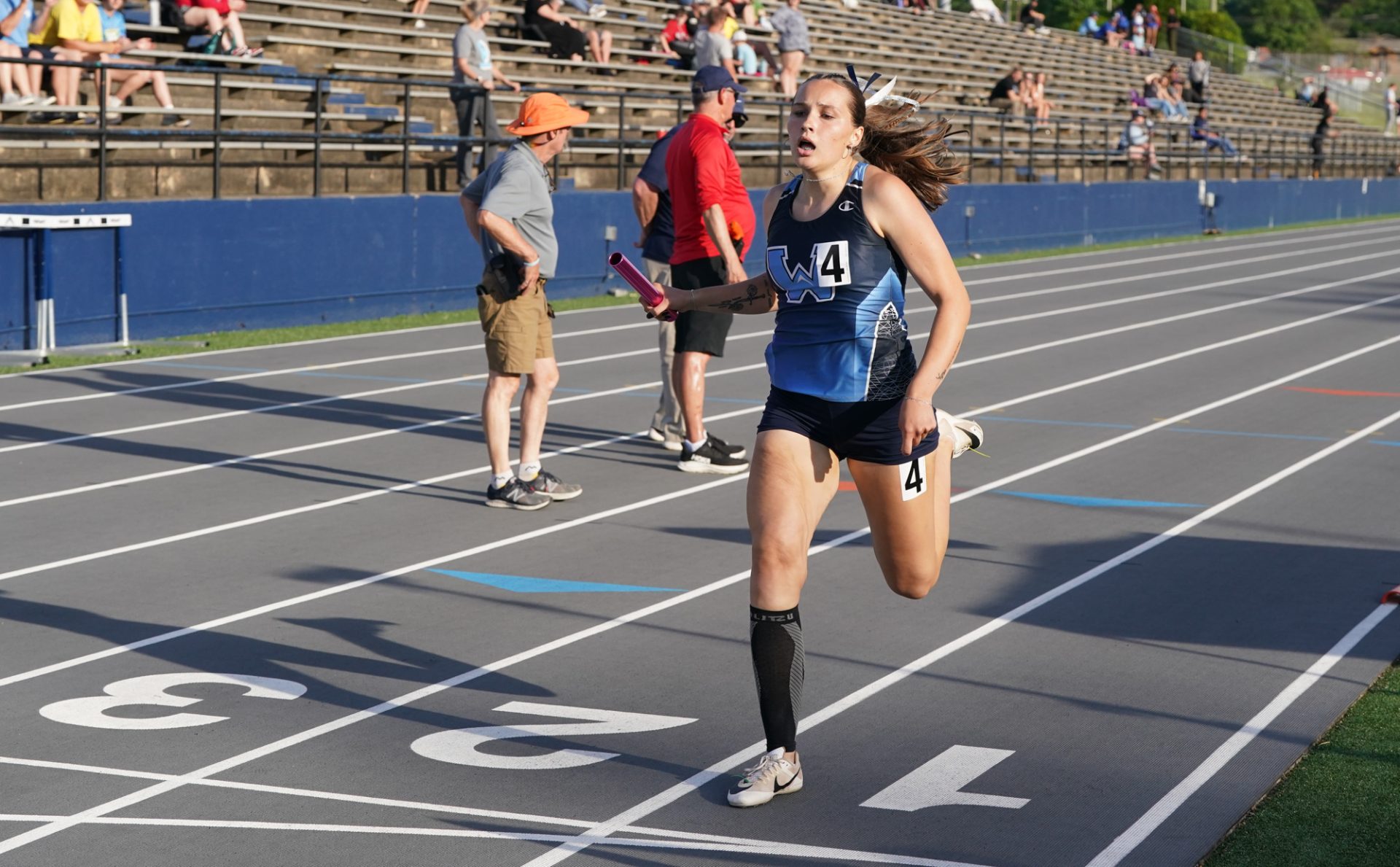
Watauga’s Charlotte Rosenbalm brings home the baton on the final leg of the Women’s 4×400 Relay on April 29 in the 6A/7A Northwestern Conference meet. Photographic image by David Rogers for Blowing Rock News
All three of Watauga’s entries in the Women’s 400 Meters finished in the Top 10, capped by Lily Stough’s No. 1 victory (58.61), the only runner in the event to eclipse the 1-minute mark. South Caldwell’s Sarah Franklin took the No. 2 spot (1:01.37), followed by No. 3 Ava Cooke of Freedom (1:01.39). Watauga’s Vivian Hans (No.6, 1:04.35) and freshman Ember Honeycutt (No. 7, 1:04.49) picked up valuable team points with their finishes.
The Women’s 300m Hurdles was another 1-2-3 sweep for the Pioneers, with Tessa Buchanan (No. 1, 46.32). Grace Scantlin (No. 2, 52.28) and Hannah Kop (No. 3, 52.90). The figured as role models for the Pioneers’ entries in the 800 Meters, with Cali Townsend (No. 1, 2:20.46), Lainey Johnston (No. 2, 2:24.34) and Lily Kimbrough (No. 3, 2:33.55) following suit for yet another 1-2-3 sweep for the Pioneers.
Although Watauga didn’t have anyone place on the podium in the earlier 100 Meters, the 200 Meters sprint race was a different story. Alexander Central’s Malayah Adams won the event (No. 1, 26.28), but Watauga had the next two finishing spots, both within about a half-second of the winner: Mackenzy Cheek (No. 2, 26.78) and Tessa Buchanan (No. 3, 26.92). Merritt Powell also made the top 10, finishing No. 7 (28.39).
The final individual running event of the evening was arguably the Pioneers’ most dominating: the 3200-Meter Run. Cali Townsend (No. 1, 12:05.09), Josie Mayo (No. 2, 12:20.53) and Susanna Goff (No. 3, 12:23.03) lapped the field in taking the 1-2-3 sweep and demonstrating Watauga’s long distance superiority, at least in the 6A/7A Northwestern Conference. South Caldwell’s Kaylee Teague ran a respectable 15:44.09 at No. 4, well ahead of her No. 5 rival, Hope Cox (16:00.75), representing Alexander Central, but put in perspective, all three of Watauga’s athletes were more than three minutes ahead of the field, running near or under their personal bests.
In the final women’s relay, the iconic 4×400, Watauga (No. 1, 4:19.64), held off a game performance by Alexander Central’s quartet (No. 2, 4:29.40), as well as St. Stephens (No. 3, 4:36.66). The Watauga relay team members: Vivian Hans, Hannah Kop, Mackenzy Cheek and Eden Krenzin.
In the field events, Watauga continued its domination with most of the teams’ athletes finishing in the top five, if not winning. The Pioneers took a 1-2-3 sweep of the Pole Vault behind Sydney Helms (No. 1, 10-09), Sophie Robbins (No. 2, 9-06), and Carrie Bradbury (No. 3, 9-00).
The Pioneers’ Lily Stough (No. 1, 19-02) captured the Long Jump conference title, with Ember Honeycutt (No. 4, 15-11.50) and Eden Krenzin (No. 5, 15-10) rounding out the top five and capturing valuable team points.
Stough also showed well in the High Jump, placing No. 2 (5-02) behind Alexander Central’s Kay’ona Connor (No. 1, 5-04). Ashlyn Smith was Watauga’ only other entrant in the event, in the mix at No. 4 (5-00).
In the demanding Triple Jump, Stough again led a trio of Pioneers, all placing in the top five of the event. Stough captured the conference title with a leap of 40-04, more than four feet further than No. 2, Alexander Central’s Carly Hendren (35-10.25). Watauga’s Eden Krenzin (No. 4, 34-03) and Sophie Kop (No. 5, 33-08.25) rounded out the top five. Alexander Central also had the No. 3 jumper in Cadence (“Cadee”) Rollins (35-00).
Alexander Central’s Ali Lewis was a double winner in capturing the Shot Put and Discus titles, going 31-07 in the Shot Put and 198-04 in the Discus. While the Pioneers didn’t place anyone in the top five of the Shot Put, two Watauga athletes made it to the top five list in the Discus: Ellie Helms (No. 2, 96-03) and Maggie Smith (No. 5, 84-05).
Mars Hill University bound Matthew Leon (to play football) of Watauga was a double gold medal winner on April 29 in the 6A/7A Northwestern Conference track meet. Photographic image by David Rogers for Blowing Rock News
MEN’S DIVISION
TEAM STANDINGS
Watauga (218)
Alexander Central (151)
St. Stephens (122)
Freedom (66)
South Caldwell (63)
McDowell (58)
Watauga won three of the four relay events, capturing the 4×100, 4×200 and 4×800. A lane violation in the 4×400 resulted in a disqualification.
The 4×800 team of Grady Gates, Levi Anderson, Brian Newmark and Calvin Zwetsloot got the Watauga men’s team started on the right foot, capturing the conference title with an 8:54.07 performance, a little more than 11 seconds ahead of No. 2 Alexander Central (9:05.62).
The 110m High Hurdles event was won by St. Stephens’ Kion-nie Banks (15.66), followed by the Pioneers’ Eli Reed (No. 2, 16.42)
.Watauga’s Nyle Peays led a 1-2 sweep of the 100 Meters, sprinting the distance in 10.66 seconds. He was followed by No. 2 Riley Ellison (10.93), the only two competitors under 11 seconds.
In the 4×200 Relay, the Pioneer quartet of Matthew Leon, Lucas Cash, Mason Harris and Riley Ellison were crowned conference champions, winning the event in 1:30.27.
James Bostrom of Watauga clocked a 4:37.14 time to secure the 1600 Meters title. Teammates Jonah Pearson (No. 3, 4:38.68) and Zeke Walker (No. 4, 4:45.04) were not far behind No. 2, Bryce Corpening of South Caldwell (4:38.06).
Watauga similarly showed off its sprint prowess in the 4×100, with the quartet of Mason Harris, Riley Ellison, Lucas Cash and Nyle Peays completing the one-lap circuit in 43.37 seconds, with Alexander Central No. 2 (44.11).
Pioneer senior Matthew Leon was the only Northwestern Conference performer to run under 50 seconds in the grueling 400 Meters sprint. His No. 1 time of 49.42, a personal best, allowed him to cross the finish line ahead of Alexander Central’s Aidan Batty (No. 2, 50.24) and Kevin Hinson (No. 3, 51.32). Leon revealed to Blowing Rock News that he has committed to play football next year for Mars Hill University, north of Asheville.
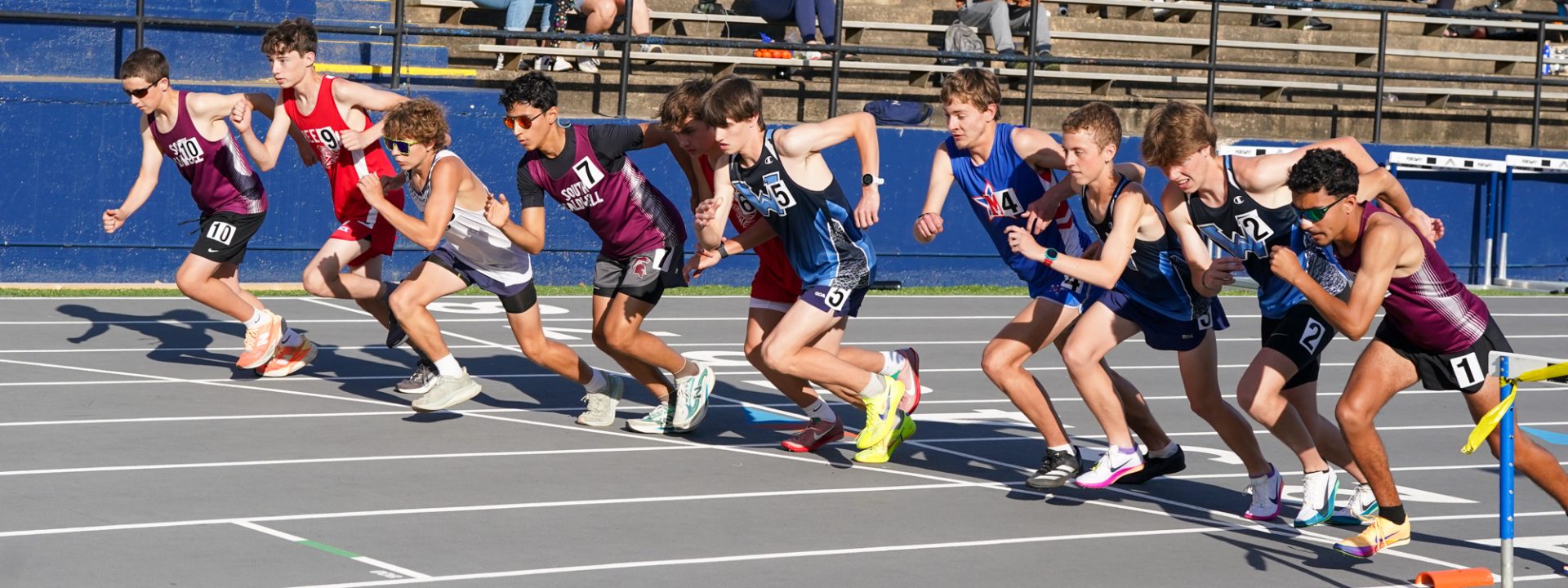
Far right, Bryce Corpening of South Caldwell has the inside edge at the start of the Men’s 3200. Corpening won, closely follwed by a 2-3-4 finish for Watauga’s Parker Williams, Calvin Zwetsloot and Isaac James. Photographic image by David Rogers for Blowing Rock News
Nyle Peays and Eli Reed completed a 1-2 sweep in the Men’s 300m Hurdles. Peays was No. 1 (39.38) and Reed was No. 2 (40.74).
Watauga’s entries in the Men’s 800 Meters took another 1-2-3 sweep to the podium, with Levi Anderson (No. 1, 2:04.72), Zeke Walker (No. 2, 2:05.40) and Brian Newmark (No. 3, 2:06.20) taking the honors.
The Pioneers followed that up with 1-2 sweep of the Men’s 200 Meters, with Nyle Peays again leading the way at No. 1 (21.69), followed by Riley Ellison (No. 2, 22.35). Mason Harris (No.4, 23.53) was also among the leaders.
South Caldwell’s cross country and long distance star Bryce Corpening showed his stuff again in the Men 3200 Meters, going No. 1 in 10:11.39. He was followed by a trio of Watauga runners: Parker Williams (No. 2, 19:16.49), Isaac James (No. 3, 10:21.77) and Calvin Zwetsloot (No. 4, 10:30.93).
In the final event of the day, the Men’s 4×400 relay, Watauga was represented by Silas Powell, Sawyer Blackburn, Derek Nix, and Eli Reed, but was disqualified for a lane violation on one of the baton exchanges.
By David Rogers. HICKORY, N.C. — Good business models often capture complementary revenue streams — and that’s exactly what Rock Barn Country Club aims to do with its ongoing renovation and expansion plans.
It is a “club”, to be sure, with members, dining facilities and recreational amenities, as well as a spa and fitness center. Among its recreational opportunities are two golf courses, a members and member-guests course designed by Robert Trent Jones, Jr., as well as another course designed by Tom Jackson that is more readily playable by the public.
Left to right, Ron Cutlip, Jon Robertson, Brad Ellinger and Marshall Robinson discuss the new features of the bunker renovations at Rock Barn Country Club. Photographic image by David Rogers for Blowing Rock News
Rock Barn is also a popular spot for hosting events, including weddings, receptions and business conferences. Somewhat central to Rock Barn’s operations is the spa, which attracts add-on revenue from every other aspect of the operation: membership, golf, tennis, lodging and retail.
While Rock Barn currently has a lodge that accommodates groups of 10-12 people for overnight stays, in a recent interview with Blowing Rock News, General Manager Brad Ellinger reported that a high-end, boutique hotel is in the planning stages.
“Rock Barn is a destination for many people in our wide geographic market footprint,” said Ellinger, “so we need individual rooms for couples and individuals to serve that market demand. We are a coveted venue for weddings and other special events, so rather than force customers to overnight stays in Hickory, Statesville or Charlotte, for example, our boutique hotel will offer a more convenient option. We expect the spa will also see additional market demand because of the hotel’s draw.”
Playing Through
Another Rock Barn operation that promises to complement the hotel and the spa are the golf courses.
“We are restoring the Robert Trent Jones, Jr. course back as close as possible to its original design,” said Ellinger, “and we want it to be in prime shape for our members and guests well before the new hotel opens. The key focus is on renovating the bunkers and we are excited about the work that is currently being done.”
Studying the bunker renovations currently ongoing at Rock Barn’s Jones course is a multi-dimensional journey into history, architectural design, technology and business. It is an ambitious project, with more than 130 bunkers — AKA “sand traps” — dotting the 7,169 yards of scenic sporting landscape.
Rock Barn’s Golf Course Superintendent Jon Robertson points to bunker erosion that developes over the years on any golf course. Rock Barn is renovating its bunkers to restore the original Robert Trent Jones, Jr. design. Photographic image by David Rogers for Blowing Rock News
Understanding Golf’s Roots
Bunkers on golf courses evolved over time. Early golf was played on Scottish coastal “links” courses where natural, wind-swept sand depressions occurred naturally while grazing farm animals created sandy “hollows.”
Today’s golf courses are no longer modified sheep and cow pastures. Modern bunkers grew out of these natural hazards to make golf more strategic. The threat of a player’s ball landing in a sand trap increases golf’s difficulty for most. Skilled professionals might purposely navigate their ball into a sand trap to get closer to the hole but bunkers challenge a golfer to hit the ball more precisely, to safer landing areas for playing a next shot.
Today’s sand traps honor golf’s origins but they also serve a more practical double-purpose, too: adding beauty to the course experience while encouraging a more profitable course operation.
“The Jones course opened in 2003,” said Rock Barn’s Director of Golf, Marshal Robinson. “Over two decades of play, we found that some of the bunker edges had risen two to three inches as golfers played out of the sand. It may only be a little bit of sand thrown up on those edges at any given time, but it accumulates. So, one of the reasons driving this renovation is the aesthetic value of restoring the bunkers.”
Rock Barn contracted High Country-based Cutlip Golf Design to lead the renovation project. Cutlip added Blowing Rock native Rick Robbins to the design team. Robbins is a past president of the American Society of Golf Course Architects and Ron Cutlip was inducted into that prestigious organization in late 2024.
New bunker technology uses a layer of Portland cement mixed with sand to quickly channel water from rainfall to drainage channels at the lowest points of the sand trap, below the white sand you typically see. Embedded in those channels are ‘chambers’ for collecting the water and directing it out to the course periphery. Photographic image by David Rogers for Blowing Rock News
Cutlip and Robbins collaborated on designing the master plan for the bunker renovation, meticulously reviewing the Jones course, hole by hole. It was Cutlip’s experience on his last major project, designing the South Shore Golf Club course in Narragansett, Rhode Island, that answered a critical question for the Rock Barn management team.
“Ron (Cutlip) told us about a newer bunker technology that we had never heard of,” said Rock Barn’s GM, Ellinger. “It sounded interesting, but we were skeptical of investing in something with which we were unfamiliar. We became convinced, though, after the technology contractor provided us with a risk-free demonstration, renovating what was ostensibly our worst bunker to show us how it works.”
On a golf course, water-logged bunkers can slow down play.
“Golf course businesses make a lot of their money based on the number of rounds that can be played in a day,” said Cutlip. “When it rains, the older style of bunker often gets water-logged. It becomes unplayable. We are introducing newer technology with this renovation project, the same technology we used at South Shore in Rhode Island.”
Enter Mark Pribble, of Atlantic Installations, based in Maryland.
“My business partner and I saw this unique construction-related process in a completely different application and thought it could have profound implications for golf course sand traps,” said Pribble. “So we negotiated to license the technology for golf course applications. Below the layer of white sand that you see in a bunker, there is a layer of Portland cement mixed with sand. This layer quickly channels the water from rain into chambers at the bottom of each bunker. Each chamber is able to handle a very large volume of water, then releases it into drainage pipes that direct it to the course periphery, into creeks and ponds or spread out over wetlands. This technology leaves the top surface of sand dry and more readily playable, which speeds up play as well as enable play.”
The chambers to collect the drained water from a bunker have fine perforations to allow water to pass through but holding back sand and gravel. Photographic image by David Rogers for Blowng Rock News
Going Pro
One of the NCAA’s most memorable taglines was introduced in the early 2000s: “There are more than 400,000 college student athletes in the U.S. and most of them will go pro in something other than sports.”
Certainly that was true for Jon Robertson, Rock Barn’s golf course superintendent. In the late 1990s, he was on App State’s football team as a quarterback but after graduating he pursued another passion as his professional occupation: in golf course management.
Bunker course nearing completion (foreground) provide a sharp contrast to a nearby bunker just getting carved back down to ‘ground zero’ as part of Rock Barn’s renovation and restoration project in the spring of 2026. Photographic image by David Rogers for Blowing Rock News
“These bunker renovations are more player friendly, aesthetically pleasing, improve the lines of sight, and help with our golf course maintenance,” said Robertson. “Like a lot of courses, we use ‘Sand Pros’ to power sweep the bunkers. With our old bunkers, these devices were also a source of erosion as they break down the edges going in and out. With the new bunkers, that process is made much more efficient. That’s going to not only improve the aesthetics, but help out our maintenance crews, too.”
From a design perspective, bunkers can define a golf hole. They add visual contrast to the playing experience (white sand vs. green turf, for example) but fairway bunkers are strategically placed to challenge both the golfer’s skill and his or her decision-making: “Do I play it safe or try to carry the bunker and get closer to the pin?” Around the green, bunkers serve to “protect” a hole, challenging the golfer’s hitting precision.
Placing bunkers — sand traps — on a golf course reveals the mischievous devil at work in the minds of golf course architects. They create beauty and deception – and now also help a course’s management.
EDITOR’S NOTE: We plan a follow-up story with images during the summer, once the grass has “greened up” and the planted turf has matured.
By David Rogers. BOONE, N.C. — Another game against No. 16 nationally ranked Coastal Carolina, another loss — but a lot to like in the narrow, 8-7 defeat.
Although the visiting Chanticleers swept the season-opening Sun Belt series from the Mountaineers, App State made them work for it in each of the three games. In Game 1, starting pitcher Nick DiRito shutout Coastal Carolina for five innings before giving up a pair of runs in inning No. 6. The Chanticleer batters pounced on three Mountaineer relievers for eight more runs the rest of the way while App State’s offense couldn’t produce anything until six runs in the seventh and eighth innings.
Tanner Nolan pitched three shutout innings against Coastal Carolina on March 15 before being chased with four runs in the 4th inning. He struck out five Chanticleer batters in the outing. Photographic image by David Rogers for High Country Sports
On March 14, another strong pitching performance from Mountaineer starter Gage Peterson (seven innings pitched, no runs on 2 hits, with nine strikeouts) could not hold up even after App State drew the proverbial first blood with four runs in innings No. 3 and No. 4. After Peterson’s departure (102 pitches facing 25 batters), Coastal Carolina’s batters touched up the Mountaineer relievers for seven runs in the eighth and ninth innings to win going away.
Then, in the finale, the Mountaineers again jumped out to an early 4-0 lead, ignited by leadoff hitter Nico Soul’s solo home run on the first pitch in the bottom half of the first inning. A 2-RBI single by Jalen Seward, and an RBi-producing bunt single by Charlie Evans followed Soul’s opening dinger, giving hope to the nearly 500 mostly App State baseball fans braving the cold and rain that this day might have a different outcome.
App State catches the Coastal Carolina runner trying to advance to second on March 15. Photographic image by David Rogers for High Country Sports
But it wasn’t to be. Starting pitcher Tanner Nolan went three scoreless innings until being chased by Coastal’s four runs scored in the top of inning No. 4. Reliever Everette Harris retired the last two batters in the inning on just three pitches with no more damage, but four more Mountaineer relievers went the rest of the way, giving up four more runs on four hits. Of the four, only the last one, Reyn Watson, emerged from the fray unscathed, giving up just one hit.
After App State added a run in the third inning (highlighted by Ethan Puig’s leadoff double) to take a 5-0 lead, CCU narrowed the deficit with four runs in the top of the fourth inning, capitalizing on three consecutive batters hit by a pitch off the arm of starter Nolan. After walking in a run and giving up a 2-RBI single to Coastal’s Ty Barrango, Nolan was sent to the showers and replaced on the mound by Harris.
The Chanticleers went ahead, 7-5, with three runs in the sixth inning, jumpstarted by Brice Estep’s leadoff blast over the left field fence. The Mountaineers responded with two runs of their own in the bottom half of the frame. After retiring the first two App State batters, the Chanticleers’ Daniel Parker gave up back-to-back singles to Steven Smith and Riley Luft before Puig doubled down the right field line, driving in Smith and Luft to tie the game at 7-7.
App State shortstop Steven Smith (7) rips a single vs. Coastal Carolina on March 15. Photographic image by David Rogers for High Country Sports
In the top of the 8th inning, reliever Cal Clark hit Coastal Carolina’s first batter, Trace Mazon, who scored what proved to be CCU’s winning run two batters later on a single by Walker Mitchell.
The winning pitcher was Coastal Carolina’s Colby Richardson and App State’s Clark was credited with the loss. Although the visitors won the game, 8-7, the Mountaineers outhit the Chanticleers, 11-9. Both teams recorded an error.
But there were two other telling game stats: Mountaineer pitchers hit a whopping six Chanticleer batters. Also, Coastal Carolina was more aggressive on the basepaths, putting runners in scoring position with two stolen bases.
With the loss, App State falls to 0-3 in Sun Belt Conference play, 10-9 overall. Coastal Carolina starts league play with an unblemished, 3-0 in Sun Belt record, 13-6 overall.
The Chanticleers will look to extend their winning streak on Wednesday, March 18, in Buies Creek, N.C., with a 1-game, non-conference tilt at Campbell University.
App State will travel to High Point on Tuesday, March 17, before moving on to Norfolk, Va. for a Sun Belt Conference series at Old Dominion.
By David Rogers. BOONE, N.C. — Starting pitcher Gage Peterson threw seven shutout innings against Coastal Carolina on March 14, allowing just two hits while walking two and striking out nine Chanticleer batters. Meanwhile, App State’s offense jumped out to a 4-0 lead after those seven innings — but it was all for naught as the visitors from Conway, S.C. jumped on the Mountaineers’ relievers in their final two at-bats to take Game 2 of the weekend series, 7-4.
App State third baseman Ethan Puig (5) rips a single up the middle in the bottom of the third inning vs. Coastal Carolina on March 14, scoring Nico Soul for the game’s first run. App State squandered an early 4-0 lead when the Chanticleers scored seven runs in the eighth and ninth innings for a 7-4 win. Photo courtesy of App State Athletics
It was a tale of opposite trends in front of a big Smith Stadium crowd of 1,119 fans on a bright and sunny baseball-perfect day. Ranked No. 16 in the nation, the visiting Chanticleers were held scoreless against Petersen while the Mountaineers were manufacturing runs through those first seven innings. In innings No. 8 and No. 9, however, App State was able to get only one runner on base in each of the final two innings while Coastal ripped four consecutive, 2-out singles to manufacture three runs in the eighth inning, narrowing the deficit to just a single run going into the final frame. Then they scored four runs in the top of the ninth, capped off by a 2-RBI home run off the bat of Trace Mazon, on a 3-2 pitch to account for the game’s final scoring.
Ryan Lynch (1-0), Coastal Carolina’s fourth pitcher in the contest, was on the mound when the Chanticleers tied the game and went ahead, so was credited as the winning pitcher. Teammate Scott Doran earned his first save. App State reliever Max Tramontana (1-1) picked up the loss.
App State and Coastal Carolina will meet in Game 3 of the weekend series on March 15, with first pitch rescheduled for 11 a.m.
By David Rogers. TAYLORSVILLE, N.C. — “When it rains, it pours…” might be an understatement in describing the Watauga varsity women’s basketball team’s 65-52 loss to Alexander Central on Feb. 28, in Round 3 of the NCHSAA 6A state playoffs.
Certainly it was raining 3-pointers early, compliments of the Cougars’ junior starting forward Ava Head and sophomore reserve forward Hannah Chapman. In the first quarter alone, Head connected on three from beyond the arc while Chapman came off the bench to add yet another.
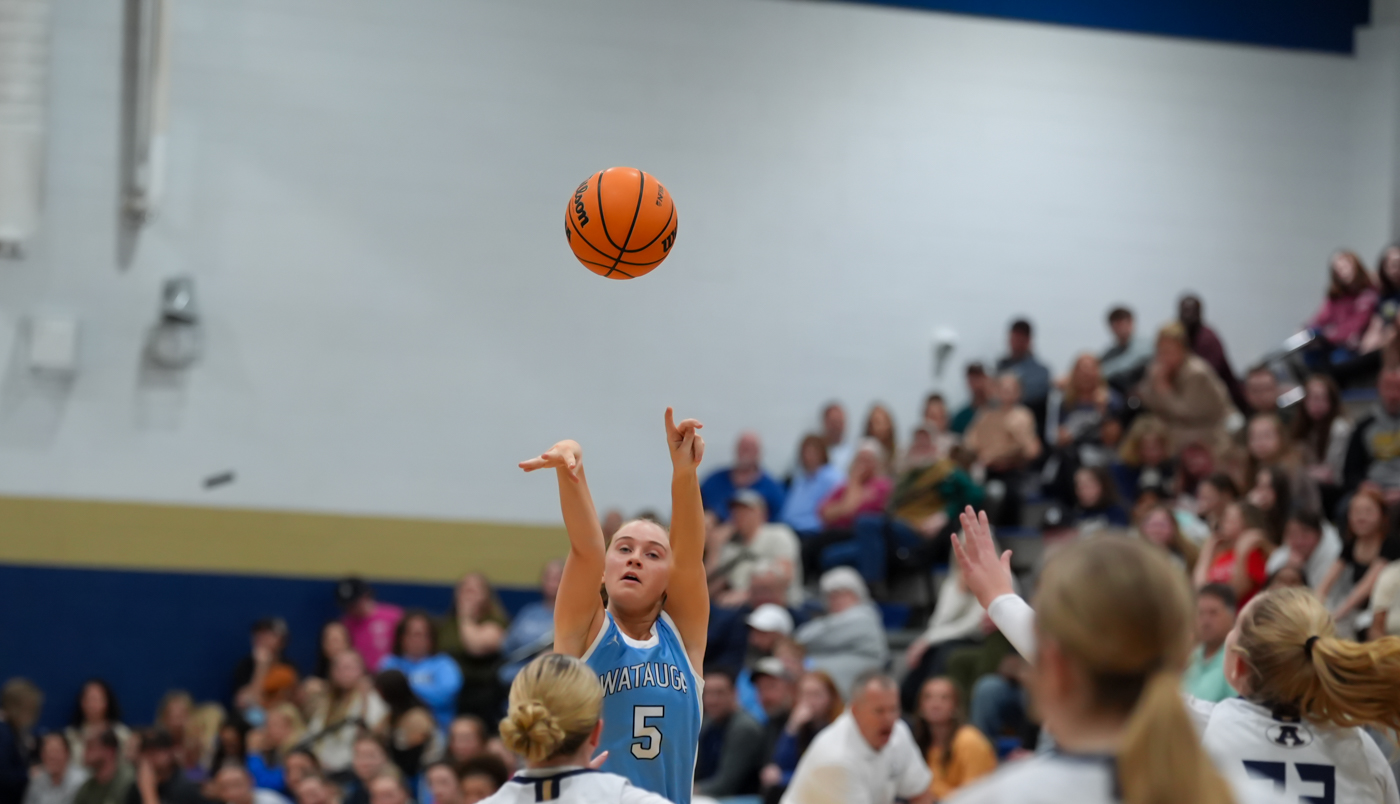
Watauga’s Izzy Torgerson sinks a 3-pointer against Alexander Central on Feb. 28. Photographic image by David Rogers for High Country Sports
Watauga’s early inability to defend the perimeter, as well as the team’s penchant for throwing long, wild passes (creating turnovers) proved to be the Pioneers’ undoing against a veteran Alexander Central team whose starting lineup is comprised of three seniors and two juniors. By contrast, the Pioneers’ starters include two seniors, two juniors and a freshman, while the first two off the bench are a sophomore and a freshman.
After the game, Watauga head coach Bill Torgerson conceded that one of the hardest things for younger, still developing players to understand, especially against a veteran side that has learned to “read” or anticipate an opponent’s passes — intercept — is patience, waiting for the best pass or shooting opportunity.
At one point in the first half, the Pioneers trailed by 16 points and it looked like the Cougars would run away with their fourth win this season over their Boone-based, Northwestern Conference rivals.
Very much to their credit, Watauga clawed its way back to a mere 3-point deficit early in the fourth quarter, but ACHS seniors Malayah Adams and Meredith Wike, as well as Head, poured in enough points to put the game away. Add in the Cougars’ pressing defense, and Pioneer mistakes were made.
It is testimony to the improving strength of the Northwestern Conference to see two NWC members playing each other in the state playoffs’ third round. While Alexander Central defeated Watauga in each of the four times they played them this season, each game has been more competitive as the younger Pioneer squad developed both individual and team skills. Watauga took ACHS to double overtime in the Northwestern Conference semifinal before losing to the Cougars, 63-61, on Adams’ buzzer beater.
Interviewed after the game and asked which Watauga players the Cougars were most concerned about, Adams quickly listed seniors Izzy Torgerson and Shelby Thompson, as well as freshman Josie Mayo.
“We know they are dangerous,” said Adams.
Both teams had three players in double figures, scoring. For Alexander Central, Adams poured in 17 points, mostly driving the lane, while Wike and Head added 16 and 17, respectively.
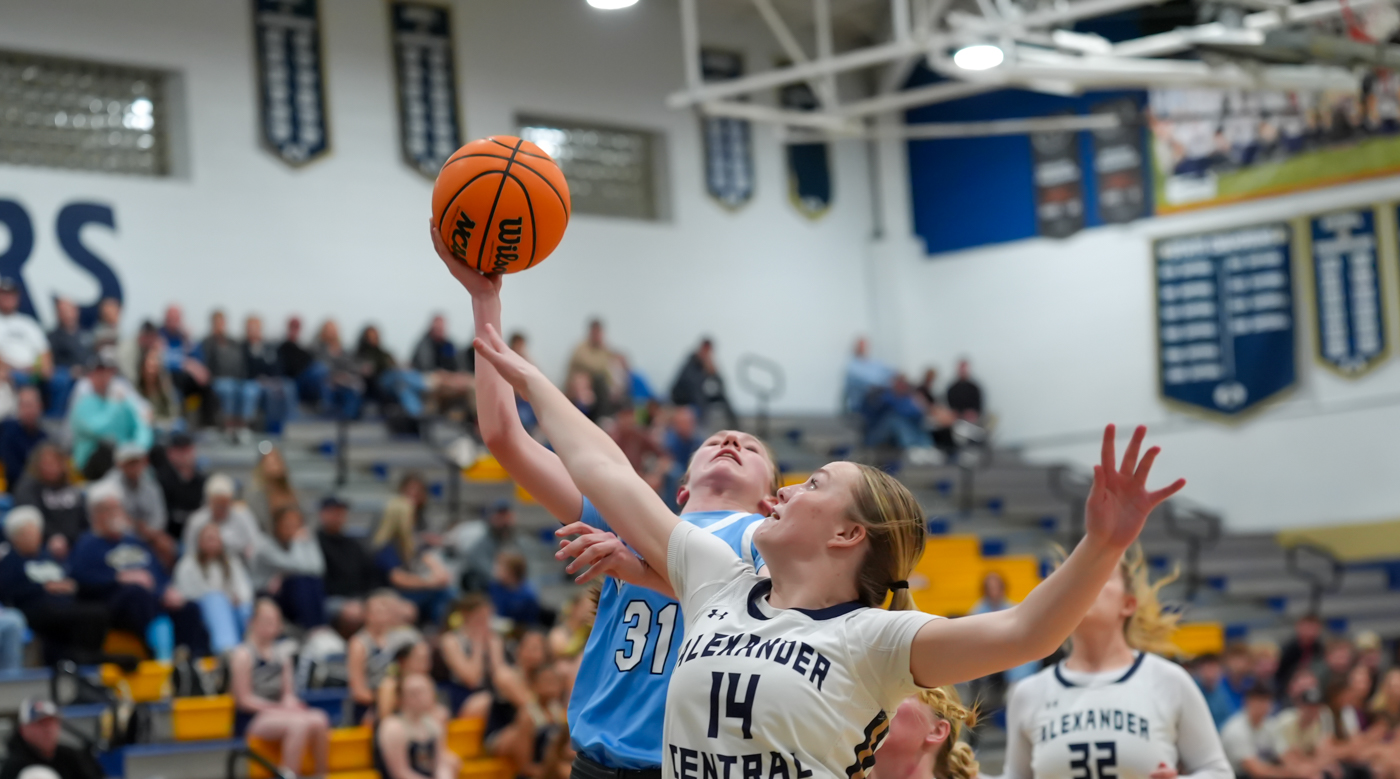
Even against a fierce defense, Watauga freshman Mia Mitchell came off the bench to score a team-high 15 points against Alexander Central in Round 3 of the 6A state playoffs. Photographic image by David Rogers for High Country Sports
For Watauga, freshman forward Mia Mitchell came off the bench to tally a team-high 15 points, while starters Torgerson and Mayo contributed a dozen each.
Coach Torgerson expressed an abundance of pride in his young team.
“At the beginning of the year, I was hopeful that we would win a couple of games, so going this far into the playoffs is a (big win for the program),” said Torgerson.
He added that this group of young athletes have been special in how much they enjoy one another.
“For most of the teams I have coached over the years, I am the one who is really positive about everything, encouraging the players. This team… they lift me up,” said Torgerson.
With the win, the playoffs’ No. 2 seeded Alexander Central advances to Round 4 where they will host No. 3 A.C. Reynolds in a quarterfinal matchup to determine who will face the winner between No. 1 Northern Guilford and No. 12 T.C. Roberson in the 6A West bracket’s other quarterfinal. A.C. Reynolds advanced by defeating No. 11 Charlotte Catholic, 60-48.
In the 6A East bracket, the quarterfinal matchups pit No. 2 Seventy-First and No. 14 Northern Durham in the lower half of the bracket, with No. 1 Terry Sanford HS hosting No. 4 Vance County in the bracket’s upper half.
All quarterfinal games are scheduled for Monday, March 2.
By David Rogers. MILLER’S CREEK, N.C. — Watauga senior pitcher Jake Blanton cruised through five and two-thirds innings on Feb. 27, giving up one run on three hits while striking out 10 batters in the Pioneers’ 8-1 season opening win at West Wilkes.
Luke Rothrock was effective as the closer, pitching one and a third innings, giving up just one hit and no runs.
Offensively, senior centerfielder Jake Blanton went 3-for-4 at the plate with a double and a pair of singles, scoring three runs while driving in another. He added three stolen bases to augment his stat line for the evening.
All told, Blanton was one of five Pioneers credited with poaching bases. The quintet also included Kwame Carter, Evan Burroughs, Easton Burns and Jack Bridgeman.
For West Wilkes, sophomore catcher Carson Snider went 1-2, scoring a run and walking once. He was knocked in by sophomore shortstop Cohen Taylor, who went 1-3 on the night.
By Jacob Plecker SAN MARCOS, Texas — Leading by one with just under two minutes to play, the App State men’s basketball team looked for one last stop to try and secure a win and a Sun Belt regular-season championship. But Texas State guard Mark Drone buried a tough jumper from the right elbow to take the lead, which helped Texas State earn a crucial, 60-57 win on its home floor.
The Mountaineers (19-12, 11-7 SBC) generated a wide-open look to try and take the lead with two seconds to play in regulation, but a corner 3-pointer from Eren Banks wouldn’t fall. Texas State (19-12, 11-7 SBC) grabbed the board and secured the victory at the other end with a pair of free throws.
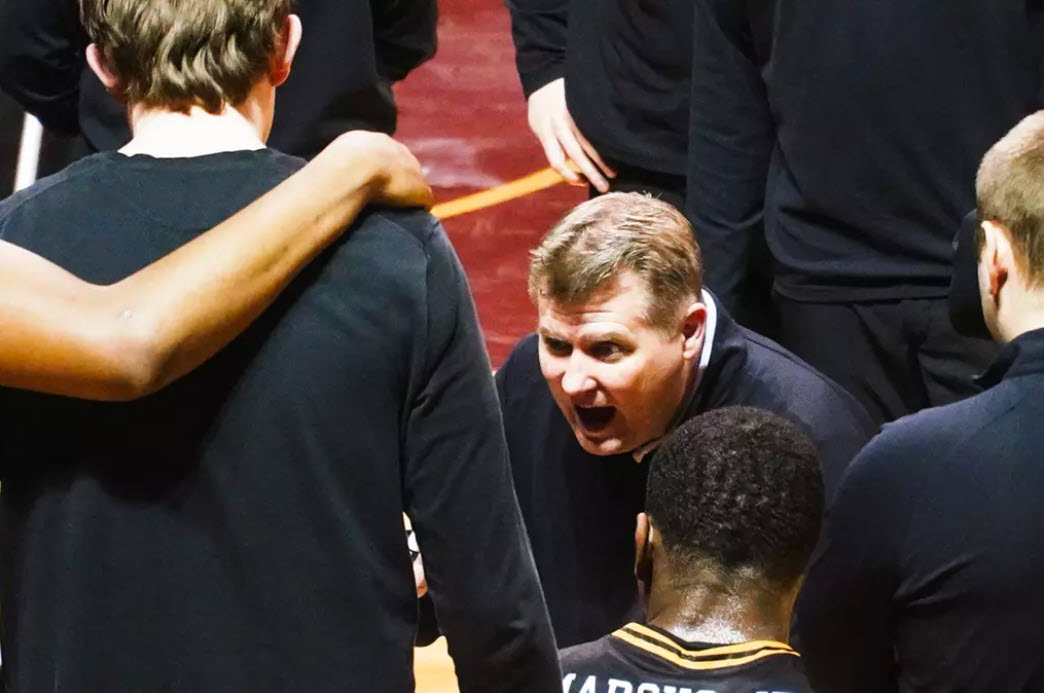
App State head coach Dustin Kerns exhorts the Mountaineers in the closing minutes of the Feb. 27 game at Texas State. Photo by Aaron Meullions, courtesy of App State Athletics
With the loss, the Mountaineers will enter the Sun Belt Tournament as the No. 4 seed, meaning they will play the winner of Game 7 on Saturday at 6:30 p.m. ET (5:30 p.m. CT). This marks App State’s third-highest seed at the tournament in the Dustin Kerns era.
App State started the game with momentum, embarking on a 17-8 run from the get-go, but Texas State regrouped and eventually took the lead at halftime. This continued into the second half as the Bobcats went ahead by as many as six points in the final 20 minutes. Although App State jumped ahead by four points with 5:08 to play in the second half, another crucial Texas State run, this one a 7-0 run, helped it take a three-point lead with less than a minute to play.
How it Happened
Despite Texas State scoring the game’s first points on a jumper from Drone, the Mountaineers wasted no time answering and jumped ahead by nine points thanks to an 11-0 run. Jalen Tot spearheaded the flurry with a four-point play before Luke Wilson and Michael Marcus Jr. capped off the run with dunks.
Texas State ended the run with a free throw and a layup, but App State jumped back ahead by nine points with 12:35 to play with another run. Alonzo Dodd was the catalyst during this spurt, as he totaled four points on back-to-back possessions.
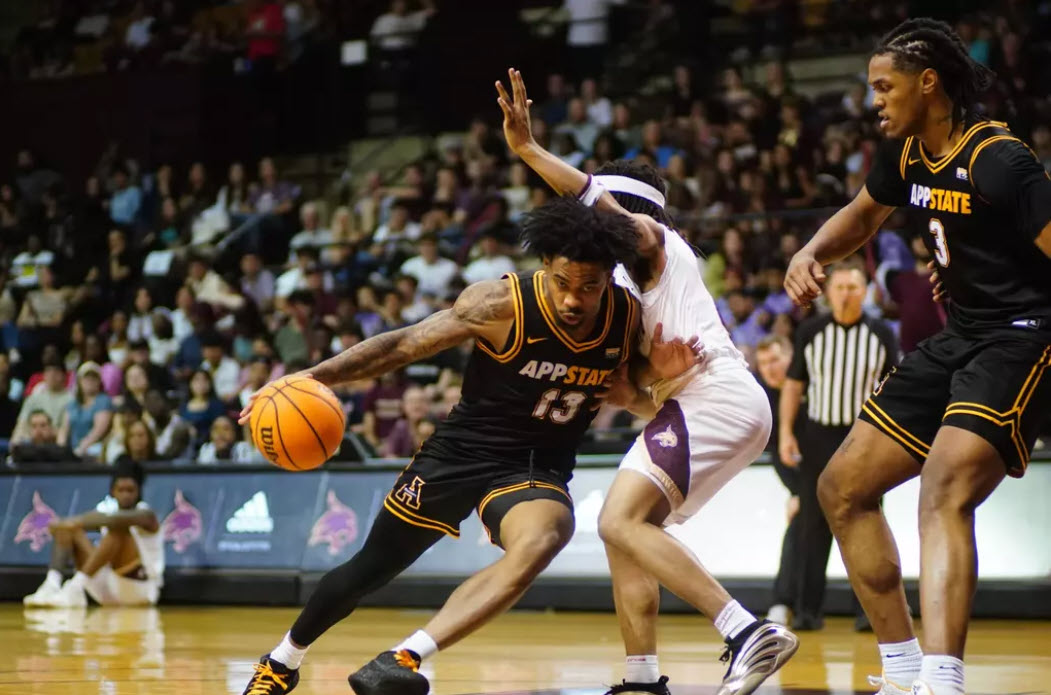
Kasen Jennings (13) looks to drive the lane vs. TExas State on Feb. 27. Photo by Aaron Meullions, courtesy of App State Athletics
Seeing their deficit balloon back up to nine, the Bobcats went to work and cut App State’s lead back down to four with less than 10 minutes to play. The Bobcats eventually tied the score with 4:48 to play in the first half, but the Mountaineers totaled four straight points, with the help of a Kasen Jennings three, to go back ahead by four by the final media timeout.
Although App State led with four minutes to go, the Bobcats ended the half strong and took a one-point lead into the halftime locker room. A Jonah Bolden 3-pointer, Texas State’s second three of the first half, helped send the large home crowd into a frenzy as the buzzer sounded.
A Wilson layup in the paint kick-started the second half and pushed the Mountaineers back ahead by a point. This was followed by a Tot 3-pointer to push App State back ahead by three, but Texas State responded with nine straight points to storm ahead by six as play hit the under-12 media timeout.
Seeing their largest deficit of the game, the Mountaineers looked for an answer and found it as Dodd and Marcus Jr. brought the score within one with 11 minutes to play. This helped spark a 6-3 spurt for App State, which gave it a one-point lead by the under-eight timeout. Another layup by Dodd pushed App State ahead 50-49 as play crept toward the home stretch.
App State’s one-point lead grew to four thanks to a Tot top-of-the-key 3-pointer. As play hit the under-four timeout with Texas State trailing by four, it looked like the Mountaineers were going to leave San Marcos with a win. This momentum was short-lived, however, as the Bobcats generated momentum of their own on their home floor, which helped them close the game strong.
The Bobcats used a DJ Hall jumper to jump-start a clutch 7-0 run that propelled them ahead by three points with just 38 seconds to play. App State finally ended the run with a Dodd layup to make the score 58-57 with 26 seconds to go in regulation. Then, Texas State missed the front end of a one-and-one, which gave the Mountaineers one last chance to take the lead in San Marcos.
With the ball in Dodd’s hands, he drove left toward the basket and found a wide-open Banks in the corner. Banks lined up his shot and fired, but it fell off the back iron. The rebound fell into Texas State’s hands, and the Bobcats sank two free throws on the other end to go ahead by three with a second left. Needing a quick 3-pointer to force overtime, the Mountaineers got a clean look from Jennings, but his shot fell short, and Texas State claimed the win on its home floor.
Top Performers
Tot and Dodd each led the way for the Mountaineers on offense, tallying 15 points apiece. Tot drilled a team-best three 3-pointers, while Dodd also recorded seven rebounds and two assists against the Bobcats. Wilson also eclipsed double figures against Texas State, while also recording his team-best 11th double-double of the season with 11 rebounds.
Up Next
The Sun Belt Tournament in Pensacola, Fla., awaits App State next. The Mountaineers have earned the fourth seed at the tournament and will play on Saturday at 6:30 p.m. ET (5:30 p.m. CT) against the winner of Game 7. All games at the Sun Belt Tournament will be broadcast on ESPN+, with the exception of the championship game, which will be broadcast on ESPN or ESPN2.
By Jacob Plecker. KNOXVILLE, Tenn. – Despite holding a one-run lead through the first four innings against No. 1 Tennessee after a Makayla McClain lead-off home run, the App State softball team couldn’t quite pull off the upset as the Volunteers rallied for six in the fifth inning to take the lead before claiming a 9-1 win. This capped off a doubleheader split for the Mountaineers, as they took down the North Carolina Central Eagles, 9-0, in five innings to open the day.
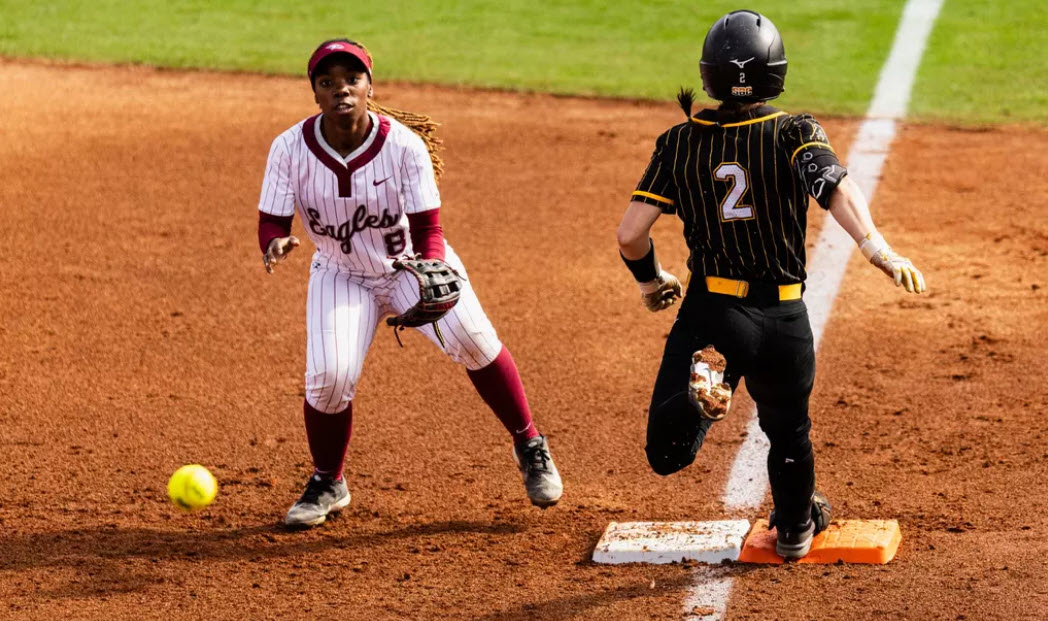
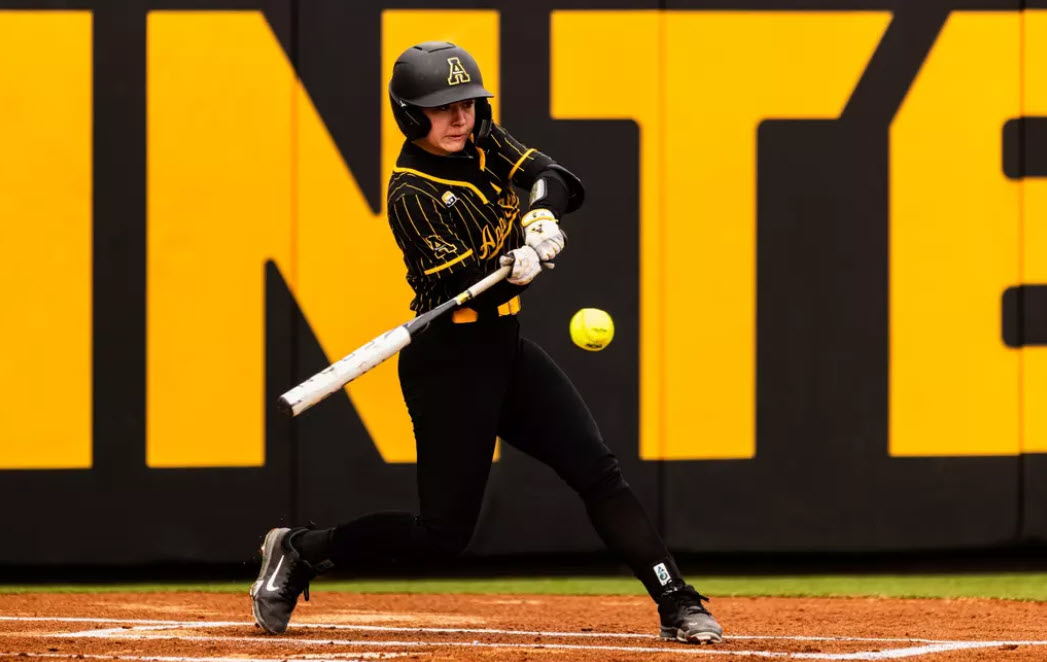
Photo by Jon Pearl, courtesy of App State Athletics
Along with her lead-off home run against the top-ranked Volunteers (15-0), McClain drove home four runs on Friday, which included a three-RBI game against N.C. Central (1-14). McClain’s home run against Tennessee’s Erin Nuwer was the first run that she has allowed all season. Additionally, Julia Girk posted a near-perfect day at the dish with three hits in four at-bats and two runs scored across the doubleheader.
Although she took the loss against the Volunteers, freshman pitcher Camryn Fisherpitched very well in her start for App State (12-3) in game two. Fisher held an offense that came into the contest averaging just over eight runs a game, scoreless through four innings. Fisher struck out four batters and didn’t allow an earned run in the game.
App State’s staff pitched well as a whole on Friday, as Sophie Moshos kicked off the doubleheader with a complete-game shutout against N.C. Central in five innings. Moshos allowed just two hits and two baserunners in the game. The Mountaineers’ pitchers allowed just three earned runs for the day.
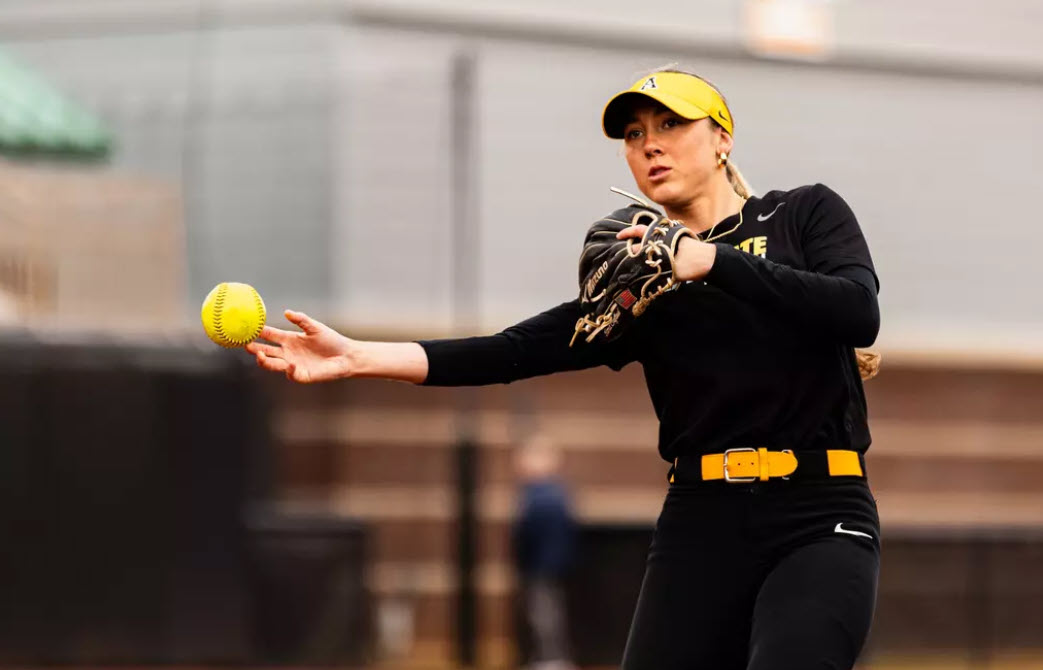
Photo by Jon Pearl, courtesy of App State Athletics
How it Happened
App State 9, N.C. Central 0 (5 Innings)
It wasn’t the fastest of starts for either team to open the doubleheader as both App State and N.C. Central were held scoreless in the first inning. The Eagles were able to retire the Mountaineers in order in the top of the second and recorded the game’s first hit in the bottom of the inning, but Moshos induced a flyout and a strikeout to end the inning.
The Mountaineers opened the scoring quickly in the third inning thanks to a lead-off triple by Girk and an RBI groundout from McClain. Following the RBI, Grace Barrettsingled into left field, and Madison Fletcher doubled her home, which immediately gave App State a 2-0 lead as play entered the bottom of the third inning.
Moshos sat down N.C. Central in order in the third inning, and App State broke the game open with a five-run fourth inning to take a 7-0 lead. Emilie Ching started the inning with a single before back-to-back singles by Marti Henkeland Girk loaded the bases with one out for McClain. Facing an 0-2 count, the Liberty, N.C., native smashed a double off the center-field wall that scored all three runners to make the score 5-0 with one out in the fourth.
Photo by Jon Pearl, courtesy of App State Athletics
McClain scored easily on a wild pitch to plate App State’s sixth run, but the Mountaineers still weren’t done as Barrett and Taylor Schaferreached to put runners on the corners for Fletcher. Fletcher produced a fly ball into right that was caught, but it was plenty deep enough to score Barrett from third, which pushed App State’s lead to seven.
App State worked around a lead-off N.C. Central single in the fourth inning to keep its lead, before scoring two more runs in the fifth to take a 9-0 advantage. Needing just three more outs to finish what she started, Moshos used just six pitches to get out of the fifth, which secured App State’s 12th win of the season.
Facing a 3-2 count against a pitcher who hadn’t allowed an earned run all season, McClain started App State’s offense with a bang by cranking a deep home run over the left-field wall to plate the game’s first run. This marked just the second time all season that Tennessee had trailed in a game (trailed No. 11 Nebraska on Feb. 13).
Seeing her offense generate run support for her, Fisher came out and retired the Volunteers in order in the bottom of the inning, and App State led by one through one. App State couldn’t add on in the second despite seeing a walk to Ching, but Fisher helped keep Tennessee off the scoreboard by working around a double and a walk to keep App State’s lead intact.
Both sides went quietly in the third inning, but the Mountaineers generated a scoring chance in the fourth. Schafer led off the inning with a single and Ching reached base on a fielding error to put two runners on with two outs. But a groundout ended the threat and kept the Mountaineers’ lead to just one through 4.5 innings.
After Fisher tallied a scoreless fourth inning, Tennessee answered with a zero in its half of the fifth. Then, the Volunteers found their offense and scored six runs to take the lead. Tennessee capitalized on two errors and three walks to post a big inning. The Mountaineers couldn’t answer in the sixth inning despite seeing a lead-off double by Barrett, and Tennessee responded with three runs to end the game early, which clinched its 15th win of the season.
App State will continue play at the Tennessee Invitational on Saturday with another doubleheader, this time against N.C. Central and No. 23 Penn State. Saturday’s doubleheader will start with a 10 a.m. first pitch against the Eagles. Both contests can be followed along via Live Stats.
By Matt Present. BOILING SPRINGS, N.C. — App State Baseball dropped its series opener Friday at Gardner-Webb, as the Runnin’ Bulldogs erased a pair of late deficits before prevailing 7-6 in 12 innings.
App State (7-2) and Gardner-Webb (7-3) will meet again Saturday at 3 p.m.
The Runnin’ Bulldogs forced extra innings with a run in the bottom of the ninth inning, then overcame a 6-5 deficit in the 12th by scoring two runs after the first two batters of the frame had been retired.
Back-to-back singles put runners at the corners before the tying run scored on a wild pitch that didn’t stray far from home plate, with baserunner Allan Camarillo barely beating the tag as pitcher Nick DiRito covered home.
After a walk put two runners on, Drew Ripepi pulled a ball to the left side for an infield single that wasn’t fielded cleanly as the shortstop went to the ground deep in the hole, with lead runner Merik Carter moving toward third and then breaking for home when the ball got away. With the fielder unable to cleanly pick up the ball and throw home, Carter scored the winning run.
DiRito’s lights-out pitching out of the bullpen put App State in position to pull out an extra-inning victory. After Gardner-Webb opened the bottom of the ninth with back-to-back doubles to tie the game at 5-all, DiRito entered the game and retired 11 of the next 13 batters he faced, striking out eight in a dominant stretch that had the Mountaineers one out away from a win with the bases empty.
App State had taken a 6-5 lead in the top of the 12th, after Jonathan Xuereb reached third with a one-out double that included a fielding error to give him an extra base. He scored on Steven Smith’s groundout to a drawn-in shortstop, who had to throw to first when he didn’t field the grounder cleanly.
The Mountaineers totaled 11 hits, led by a 5-for-5 night at the plate from Drew DuPont.
Both teams had four-run third innings, with Nico Soul producing a 4-0 lead with a three-run double in the top half, and App State took a 5-4 lead on DuPont’s sacrifice fly in the fifth inning. The score remained the same until Gardner-Webb’s back-to-back doubles in the ninth.
App State relief pitcher JJ Garcia, who entered the game with two away and the bases loaded in the fifth, retired the next batter on a flyout to left and pitched a perfect sixth. He gave way to Logan Tibbettwith two on and nobody out in the seventh, and Tibbett issued a one-out walk to load the bases, but he escaped the jam thanks to a foulout to third and a strikeout.
Tibbett pitched a perfect eighth and was replaced by DiRito following the consecutive doubles in the ninth. A groundout, strikeout and lineout pushed the game to extra innings.
App State loaded the bases with one out in the 10th inning before grounding into a double play, and DiRito struck out the side in the bottom of the 10th. He followed a leadoff double in the bottom of the 11th with three straight strikeouts.